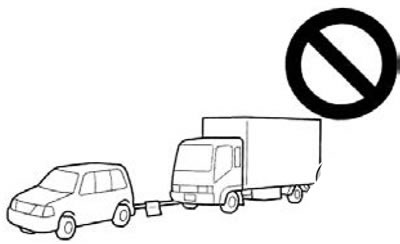
If you need to tow your vehicle
If towing is necessary, it is recommended to contact an authorized Mitsubishiman service center or a commercial towing service.
You can tow a car with a tractor in the following cases:
- The engine is running but the car does not move or there is an unusual noise.
- There is no oil in the automatic transmission.
Only if assistance from an authorized Mitsubishiman service center or a commercial towing service cannot be obtained should the vehicle be carefully towed in accordance with the instructions in "Emergency Towing" in this chapter.
Towing regulations vary from country to country. It is recommended to strictly follow the traffic regulations of the country in which the vehicle is operated.
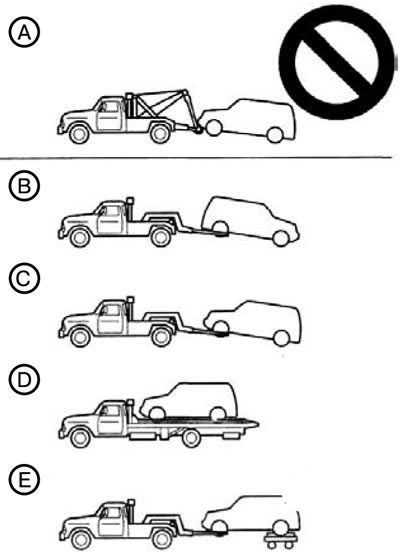
Towing a car with a tow truck
Attention:
- Towing a vehicle using a tow truck equipped with a lifting winch (type A) as shown in the figure is prohibited. The winch cable will damage the bumper and the front of the car.
- If a vehicle with an automatic transmission needs to be towed more than 50 km, it must be transported with all wheels off the ground (type D or E) or rear wheels (type B) as shown in the figure.
- In case of malfunction or damage to the gearbox, the vehicle must be transported on a tow truck platform or trailer (type D or E), as shown in the figure.
- The transfer case lever must be in the 2H position. Do not tow the vehicle if the transfer case lever is in the 4H, 4HLc or 4LLc position and the front or rear wheels are on the ground (type B or C), as shown in the figure. This may result in damage to transmission components; in addition, the vehicle may become detached from the tractor, which will lead to an accident.
Towing a vehicle with the front wheels raised (Type C)
Release the vehicle's parking brake.
Shift into neutral (N) on a manual transmission or move the automatic transmission selector lever to N (neutral).
Towing a vehicle with the rear wheels raised (Type B)
Shift into neutral (N) on a manual transmission or set the automatic transmission selector to N (neutral). Turn the ignition key to the ACC position, set the steering wheel to the straight-ahead position and secure it with a rope or cable. When towing, do not turn the ignition key to the LOCK position. This is dangerous because it may lock the steering wheel.
Attention:
- [Only vehicles equipped with MITSUBISHI Active Stability Control and Traction Control (M-ASTC)]
- When towing a vehicle with the ignition on and only the front or only the rear wheels off the ground, the active traction control system may be activated, resulting in an accident.
Emergency towing
If in an emergency it is not possible to contact a towing service, the vehicle can be towed using a cable or chain secured to a special eye.
If you need to tow your vehicle with another vehicle or when towing another vehicle, pay special attention to the following rules:
When towing a vehicle with another vehicle
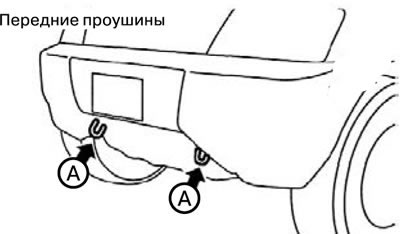
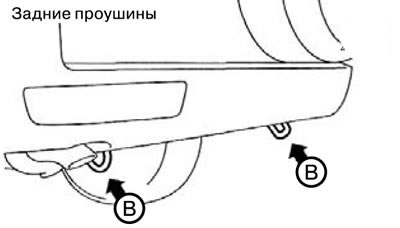
1. The location of the front (A) and rear (B) towing eyes is shown in the figures. The towing rope must be attached to these eyes only.
Note:
- Using a steel cable or chain for towing may cause damage to the vehicle body. It is recommended to use a non-metallic cable. When using a steel cable or chain, they should be wrapped in rags at the points of contact with the vehicle body.
- The tow rope should be positioned as close to horizontal as possible. An inclined towing rope can damage the vehicle body.
- The towing rope should be attached to the same side on both vehicles so that it is positioned as close as possible to the direction of the travel axis.
- It is prohibited to tow a vehicle that has driven into a ditch, since in this case the towing cable cannot be positioned horizontally.
2. Do not turn off the engine. If the engine does not start, turn the ignition key to the ON or ACC position to unlock the steering wheel.
Attention:
- If the engine is not running, the brake booster and power steering pump will not function. In this case, you have to press harder on the brake pedal, and more effort is required to turn the steering wheel. In this case, driving the car is more difficult than usual.
- While driving, do not turn the key to the LOCK position or remove it from the ignition switch. The steering wheel may lock, resulting in loss of control.
3. Shift into neutral (N) on a manual transmission or move the automatic transmission selector to N (neutral).
4. Move the transfer case lever to position 2H.
5. Turn on the hazard warning lights if required by the Road Traffic Regulations. (Comply with the requirements of the Road Traffic Regulations and other applicable regulations.)
6. Before towing begins, the drivers of both vehicles must agree on conventional signals or another method of communication. Cars must move at low speed.
Attention:
- To prevent exhaust gases from the towing vehicle from entering the passenger compartment of the towed vehicle, set the air conditioner switch to recirculation mode.
- Avoid sudden braking, sudden acceleration and abrupt maneuvering; this may result in damage to the towing eyes and towing cable. People nearby may be injured.
- When driving downhill for a long time, the brakes may overheat, which will reduce their effectiveness.
- When towing a vehicle with an automatic transmission with the drive wheels on the ground, do not exceed the maximum towing speeds and distances listed below. Otherwise, the gearbox will be damaged.
- Towing speed: 50 km/h Towing distance: 50 km.
When towing another vehicle
The location of the rear towing eyes is shown in the figure. Attach the towing rope to the rear towing eye.
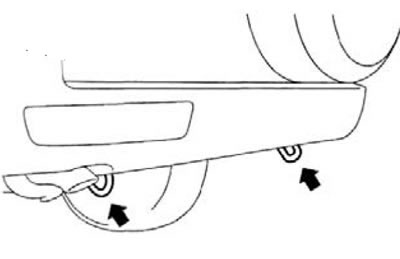
Caution: To tow another vehicle, move the transfer case lever to the 4H position. Towing in 2H mode may cause an increase in differential oil temperature and subsequent damage to the transmission. In addition to two, the transmission experiences increased loads, which can lead to oil leaks, jamming of parts and other serious malfunctions.
Information copied from the website: www.mitsubishiman.ru
Note: Only vehicles whose mass is less than the mass of the towing vehicle may be towed.