



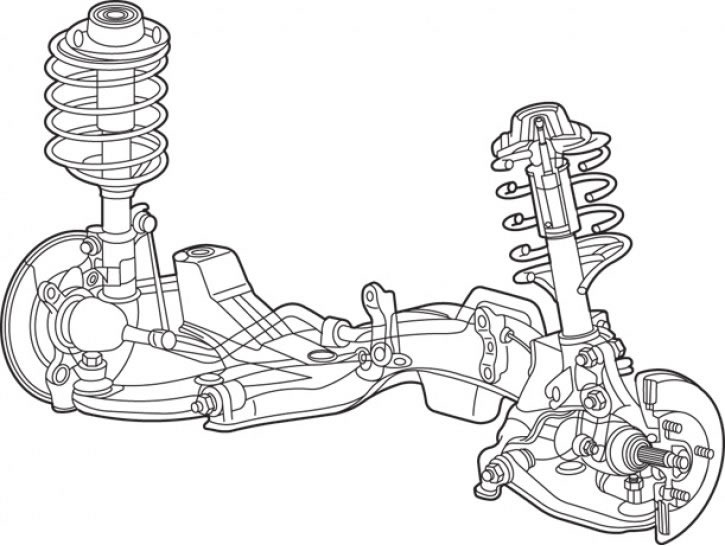
Fig. 15.1. Front suspension
The suspension is the link between the body and the wheels (Fig. 15.1). It transmits forces acting on the wheels to the body. The suspension serves to reduce dynamic loads, reduce body vibrations, soften the impact of wheels on uneven roads, and ensures stability and smoothness of the car. The suspension geometry and its rigidity determine the body's ability to move and reduce angular vibrations around the longitudinal and transverse axes of the car.
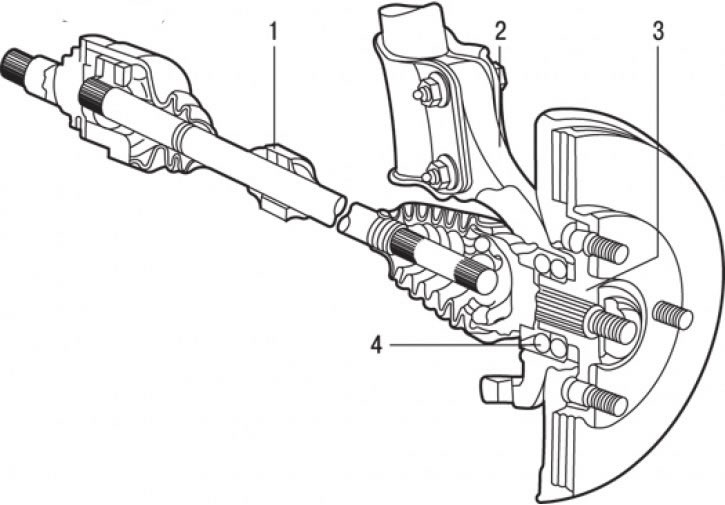
Fig. 15.2. Drive shaft and front wheel hub: 1 – dynamic damper; 2 – steering knuckle; 3 – front wheel hub; 4 – front wheel hub bearing
The front wheel hub and ball bearing are installed with tension in the steering knuckle. The splines of the drive shaft are inserted into the hub, for which it serves as a support (Fig. 15.2).
To increase the efficiency of the transmission and reduce noise and vibration, constant velocity joints (CV joints) are used in the drive shaft: on the hub side - the "Bierfeld" (BJ) type, on the gearbox side - the "Tripod" (TJ) type.
Front suspension McPherson (telescopic spring struts with coil springs). Double-acting hydraulic shock absorbers.