



Checking the primary winding of the ignition coil and power transistor (GDI and 4G13-MPI)
1. Use an analog meter to check.
2. Connect the negative probe of the device to contact 1 of the ignition distributor connector, and the positive probe to contact 2 of the connector (Fig. 9.3).
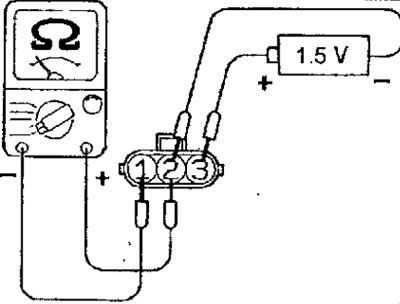
Fig. 9.3. Checking the primary winding of the ignition coil and the power transistor
Warning: This test must be performed within 10 seconds, otherwise the ignition coil winding may burn out and the power transistor may be damaged.
(Original source of information MitsubishiMan.ru)
3. Connect the positive pole of the 1.5 V power source to pin 3 of the ignition distributor connector, and the negative pole of the power source to pin 2 of the connector, the device should show current flow, and when the power source is disconnected, the device should not show current flow (see Fig. 9.3).
4. If the test results do not give a positive result, replace the power transistor.
Checking the secondary winding of the ignition coil (GDI)
It is not possible to check the resistance of the secondary winding of this ignition coil because there is a diode built into the secondary winding circuit. Therefore, check the secondary winding as follows.
1. Disconnect the connector from the ignition coil.
2. Remove the ignition coil and connect the new spark plug to the ignition coil.
3. Connect the connector to the ignition coil.
4. Connect the spark plug housing to the ground and turn the engine crankshaft with the starter.
5. Make sure that sparking occurs between the spark plug electrodes.
6. If there is no spark, replace the ignition coil and repeat the test.
7. If sparking is observed after using a new ignition coil, it means that the removed ignition coil is faulty and must be replaced.
If there is no spark when using a new ignition coil, the ignition coil circuit may be faulty. Check the ignition circuit.