
English Русский
Български
Беларускі
Український
Српски
Hrvatski
Română
Polski
Slovenský
Magyar
Articles Bookmark Contacts Sitemap   
Company Audi Company Ford Company Hyundai Company Kia Company Mazda Company Mercedes-Benz Company Nissan
MitsubishiMan.ru


Home Colt Lancer Galant L200 Outlander Pajero Others
Colt 5 (1995-2003, petrol) Colt 4 and 5 (1991-2003) Colt 2 and 3 (1983-1993)

Procedure for conducting a technical inspection of the air conditioning system (Mitsubishi Colt 4)

  • Home
  • Colt
  • 4 (1991-2003)
  • Electrical equipment
  • Heating and air conditioning
  • Procedure for conducting a technical inspection of the air conditioning system
0
Contents: Replacing the sealing ring ⤓ Maintenance of cooling system lines…⤓
Before performing any inspection that requires opening refrigeration lines or system components, it is important to thoroughly understand the rules for handling refrigerant in refrigeration system lines and fittings and the safety rules for handling chemicals.

When assembling the joint, always use new O-rings soaked in clean 525 grade cooling oil. It is much easier to assemble the parts lubricated with oil, and the oil will also ensure the tightness of the joint. When tightening the joints, use a second wrench to hold the stationary parts of the joint more firmly. This will ensure the strength of the assembly.

Replacing the sealing ring
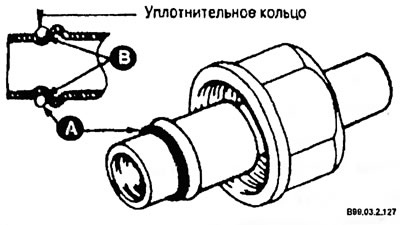


Each time you remove a joint or fitting, you must install new gasket rings intended for replacement in the air conditioning system, unless these rings are already installed on new parts. Although all O-rings look the same, it is extremely important to use only those recommended for replacement in the air-conditioning system when changing, as otherwise there may be a refrigerant leak.


When replacing O-rings on air conditioning components, it is important to accurately determine the configuration of the fitting so that the replacement ring will fit the contour of the component. Some butt joints and components have so-called "grab" fittings, which have grooves to hold the O-rings, but there are also those that do not have a groove and use "non-grab" or "standard" O-rings, the installation and tightening process for both designs is the same, but the O-rings are different.

Before installation, also check that neither the rings nor the fittings are damaged or deformed. Deformed or damaged parts must be replaced.

Maintenance of cooling system lines and fittings


Flexible hose lines must not be twisted to a radius greater than four times the hose diameter.

Flexible hose lines should be inspected regularly as they may leak due to their fragility and replaced with new lines if a leak or line break is detected.

[The original article was published on: www.MitsubishiMan.ru]

Before you disconnect a fitting in the cooling system, you must first drain all the refrigerant. This must be done very carefully, regardless of the reading on the gauge. Open the system very slowly, keeping your face and hands away so as not to injure them if liquid refrigerant suddenly appears in the line. If you notice that the refrigerant is under pressure when loosening the fitting, first relieve the pressure as described when discharging, adding oil, evacuating and charging the air conditioning system.


If you find one of the refrigeration lines open, immediately replace the caps or tighten them to prevent moisture and dirt from getting in and causing wear on the compressor's internal parts or blocking the line, condenser and evaporator core tubes, expansion (expansion) tube or compressor inlet filters.

When installing connections on O-ring fittings, it is necessary to use the appropriate wrenches. To prevent the connecting lines or components from being bent, the fitting on the opposite side should always be supported with a wrench. When connecting flexible hose connectors, it is important that the stamping fitting and flare nut, as well as the coupling to which they are attached, are held simultaneously with three different wrenches, which will prevent the fitting from rotating and prevent damage to the main seat.

The sealing rings and seats must always be in excellent condition. A burr or piece of dirt can cause a coolant leak. When replacing the sealing ring, first dip it in clean 525 viscosity cooling oil.
This article is available at: russian, bulgarian, belarusian, ukrainian, serbian, croatian, romanian, polish, slovak, hungarian
This article was reviewed by: Nikita Romanov
Share with friends:
◀ Previous
Colt 4 and 5: Heating and air conditioning
Next ▶

Checking the air conditioner drive
Basic elements of the air conditioning system
Description of the operation of the air conditioning system
Removal and installation the fan
Troubleshooting Fan Motor
Unloading the air conditioning system
Air conditioning compressor
Diagnostics of air conditioning system malfunctions
Rules for using the heater and air conditioner
Similar materials for other Mitsubishi models

➤ Technical data of the brake system Mitsubishi Lancer 3 and 5 (1984-1992)
➤ Heating, ventilation and air conditioning system Mitsubishi Galant 6 and 7 (1987-1998)
➤ Ventilation, heating and air conditioning system Mitsubishi L200 4 (2005-2014, diesel)
➤ Technical characteristics of the steering system Mitsubishi Outlander 1 (2003-2008)
➤ Technical characteristics of the brake system Mitsubishi Pajero 1 and 2 (1982-1999)
➤ General information about the air conditioning system Mitsubishi Carisma (1995-2004)
Link in different formats to this article
Comments and feedback from visitors
No comments yet


Add up two numbers 36 + 22


Colt 5 (1995-2003, petrol) 
  • General information
  • User manual
  • Specifications
  • Gasoline engines
  • 4G1 engines until 1995
  • 4G1 engines since 1995
  • Repair of 4G9 engines
  • Cooling system
  • Reduced exhaust gas toxicity
  • Engine electrical equipment
  • Injection system MPI
  • Carburetors
  • Transmission
  • Clutch and drive shafts
  • Manual gearbox F4M21/F5M21
  • Manual gearbox F4M41
  • Automatic gearbox F4A21
  • Automatic gearbox F4A41
  • Chassis and running gear
  • Car suspension
  • Steering
  • Brake system
  • Body
  • Exterior (external elements)
  • Electrical equipment
  • Equipment and devices
  • Electrical circuits
Colt 4 and 5 (1991-2003) 
  • General information
  • Maintenance
  • Power unit
  • Engine in a car
  • Engine repair (gasoline)
  • Engine repair (diesel)
  • Lubrication system
  • Cooling system
  • Carburetor
  • Fuel injection MPI
  • Fuel injection GDI
  • Emission reduction
  • Fuel system (diesel)
  • Ignition system
  • Exhaust system
  • Transmission
  • Clutch
  • Manual gearbox
  • Automatic gearbox
  • Drive shafts
  • Chassis and running gear
  • Chassis malfunctions
  • Front suspension
  • Rear suspension
  • Steering
  • Wheels and tires
  • Brake system
  • Body and interior
  • Body elements
  • Electrical equipment
  • Equipment and devices
  • Power devices
  • Heating and air conditioning
  • Electrical circuits
Colt 2 and 3 (1983-1993) 
  • General information
  • User manual
  • Daily care
  • Maintenance
  • Power unit
  • Engine in a car
  • Engine overhaul
  • Cooling system
  • Heater and air conditioner
  • Power and exhaust system
  • Engine electrical equipment
  • Emission reduction
  • Transmission
  • Mechanical gearbox
  • Automatic gearbox
  • Clutch and axles
  • Chassis and running gear
  • Brake system
  • Car suspension
  • Steering
  • Body and interior
  • Body and elements repair
  • Electrical equipment
  • Equipment and devices
  • Electrical circuits
MitsubishiMan.ru © 2018–2026 • Mobile version • Articles about Mitsubishi • Contacts • Sitemap: EN BG BY UA RS HR RO PL SK HU • Site search • Bookmark
Colt 2 and 3 (1983-1993) · Colt 4 and 5 (1991-2003) · Colt 5 (1995-2003) · Lancer 3 and 5 (1984-1992) · Lancer 9 (2000-2007) · Galant 5 (1983-1989) · Galant 6 and 7 (1987-1998) · L200 4 (2005-2014) · Outlander 1 (2003-2008) · Pajero 1 and 2 (1982-1999) · Pajero 4 (2006-2021) · Carisma (1995-2004) · Space Star (1998-2005) ·
This resource sets cookies 🍪 to avoid bothering you with repeated data entry.