



Contents: Compressor ⤓ Bypass valve ⤓ Capacitor core ⤓ Expansion tube (outlet) ⤓ Evaporator core ⤓ Battery ⤓ Heater core ⤓
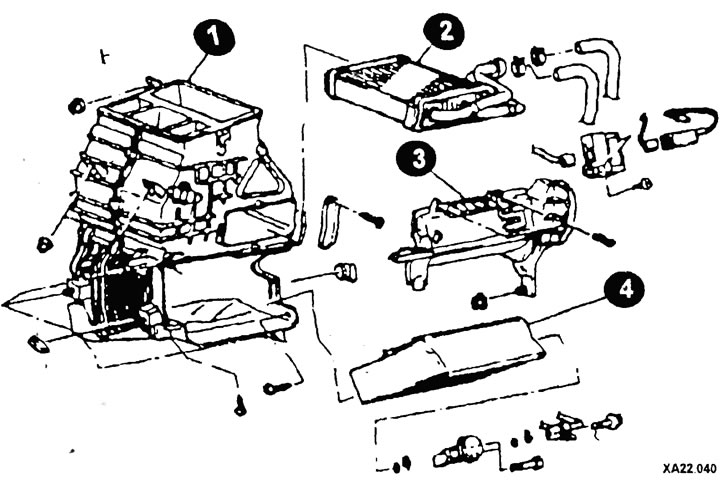
Elements of the air conditioning system
1 - heater; 2 - capacitor; 3 - lid; 4 - evaporator.
Compressor
All compressors operate on a belt drive, which is carried out from the crankshaft through a clutch pulley. The compressor pulley rotates but does not set the compressor shaft in motion until the electromagnetic winding of the clutch is excited. When voltage is applied to excite the winding of the clutch, the clutch disc assembly with the hub moves back towards the pulley. The magnetic force closes the clutch disc and pulley into one unit, as a result of which the compressor shaft begins to move. The movement of the compressor shaft causes the low-pressure refrigerant vapor in the evaporator to be compressed and exit from there already under high pressure. Cooling oil, which is used to lubricate the compressor, also exits with the refrigerant.
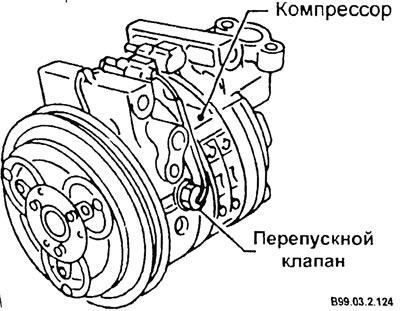
Bypass valve
The compressor is equipped with a bypass valve, which acts as a safety device in the system. Under certain conditions, the refrigerant on the discharge side may exceed the rated operating pressure. To prevent damage to the system, the valve is designed to open automatically at a pressure of approximately 3036 kPa. In some cases (defective high-pressure switch, no cooling electric fan, etc.), the valve may open, and then the fault that caused the valve to operate must be eliminated, and the cooling oil and refrigerant must be replaced if necessary.
Capacitor core
The condenser unit, located in front of the radiator, consists of spirals through which the coolant flows and cooling fins that provide rapid heat exchange. Air passing through the condenser cools the high-pressure steam, it condenses and turns into liquid.
Expansion tube (outlet)
The plastic expansion tube, together with the mesh filter and the outlet, is located in the inlet pipe of the evaporator at the connector of the liquid pipe. Its purpose is to limit the high-pressure liquid refrigerant in the liquid pipe and at the same time measure the flow of refrigerant to the evaporator. The expansion tube and outlet are protected from contamination by mesh filters on both sides, the outlet and the inlet. During maintenance, this tube is not repaired, it is replaced with a new one. When the engine is turned off and the air conditioning system is running, the refrigerant in the system will flow from the high-pressure side of the expansion tube (outlet) to the low-pressure side until the pressure equalizes. This can be determined by a slight sound of flowing liquid for 30-60 seconds, which is a normal condition.
Evaporator core
An evaporator is a device that cools and humidifies the air before it enters the car. High-pressure liquid refrigerant flows through an expansion tube (outlet to the low-pressure zone in the evaporator). The heat of the air passing through the evaporator core is transferred to the cooling surface of the core, and thus the air is cooled. While the process of heat exchange from the air to the surface of the evaporator core is in progress, all the moisture contained in the air condenses on the outer surface of the evaporator core, and then is discharged from there in the form of water.
Battery
The sealed accumulator unit connected to the evaporator outlet pipe acts as a container for storing the refrigerant, into which steam and some liquid enter, as well as cooling oil from the evaporator. At the bottom of the accumulator there is a desiccant-moisture absorber, penetrating the moisture into the system. The drain device is also located near the lower edge of the accumulator outlet pipe, and through it the oil returns to the compressor. The technical fitting of the Schrader valve of the low-pressure side is located at the top of the accumulator. During maintenance, the accumulator is not repaired, but replaced with a new one.
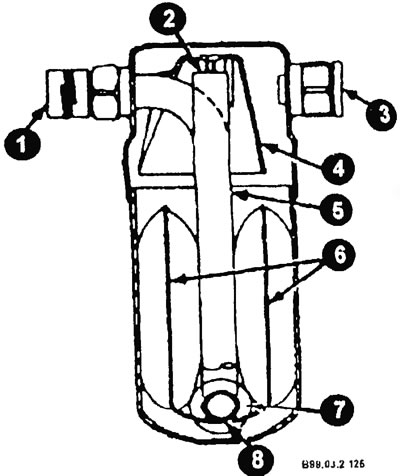
1 - conclusion; 2 - inlet for refrigerant vapor; 3 - entrance; 4 - guide partition; 3 - inner tube; 6 - package with desiccant; 7 - filter; 8 - location of the drain device on the pipe.
Heater core
The heater core increases the temperature of the air before it enters the car. Engine coolant circulates through the core and heats the outside air as it passes over the fins of the core. The core operates continuously and can be used to combine air conditioning, heating, or ventilation.