



Warning: Extreme caution must be exercised when performing this test due to high voltages in the ignition system.
1. If the engine cranks over but does not start, disconnect the spark plug wire from one of the spark plugs and attach it to a calibrated spark tester (available at auto parts stores).
2. Attach the tester clamp to a bolt or metal bracket on the engine (see illustration). If you do not have a calibrated spark tester, disconnect the wire from one of the spark plugs, then use an insulated tool to clamp the end of the wire approximately 6 mm from ground.
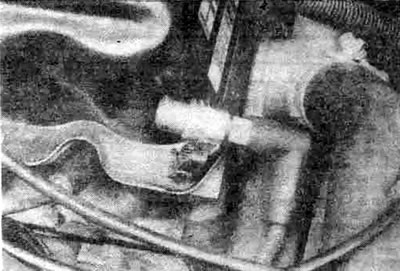
6.2 When using a calibrated spark tester, disconnect the spark plug wire, connect it to the tester, then connect the tester to ground; if the secondary voltage is sufficient, when the engine is turned over, a spark will be clearly visible between the tip of the electrode and the body of the probe.
3. Crank the engine and check for a strong, bright blue spark at the end of the spark plug wire or test lead. If you do not have a test lead, have an assistant crank the engine.
Warning: Do not touch the drive belt or other moving parts of the engine to avoid injury.
4. If there is a spark, then the correct voltage is reaching the plug (repeat the test on the remaining plugs to ensure that the wires, distributor cap and rotor (if any), and other coils in DIS systems are OK). However, the plugs themselves may be dirty, so remove them and test as described in Chapter 1.
[The text of the article was taken from the website: mitsubishiman]
5. On models without DIS, if sparking is absent or intermittent, remove the distributor cap and check the cap and rotor as described in Chapter 1. If you find moisture, dry the cover and rotor, then replace the cover.
6. On models without DIS, if there is still no spark, disconnect the ignition coil secondary wire from the distributor cap and attach it to a tester (attach the spark plug wire to the spark plug), then recheck the spark plugs. If you do not have a tester, clamp the end of the wire about 6 mm from the ground. If spark now appears, the fault may be in the distributor cap, rotor or spark plug wires.
7. If there is no spark, check the wire connections on the coil, make sure they are clean and tight. Check the voltage at the coil. Make any necessary repairs, then retest.
8. On non-DIS models, if there is still no spark, the wires from the coil to the cover may be faulty (check the resistance with an ohmmeter - it should be 7000 ohms per foot or less). If there is no difference in readings when testing a good wire, the ignition module may be faulty.