



Checking tire pressure
To operate your vehicle safely, you need to maintain a certain pressure in your tires. Remember that a tire with half the required pressure will at first glance appear to be properly inflated.
Every day before driving, visually determine the tire pressure. If it is noticeable from the outside that the pressure in one tire is lower than required, use a pressure gauge to check the pressure in all tires and, if necessary, bring it to normal.
Note: When checking the air pressure in your tires, make sure you connect the gauge to the tire valve correctly. If you connect the gauge to the valve at an angle, you may bend the valve core, causing air to bleed out.
To maintain optimum tire performance, check tire pressure only when tires are cold. Under- or over-inflated tires can cause uneven tread wear.
Underinflation is one of the most common causes of tire cracking, tread separation, or blowouts, resulting in unexpected loss of vehicle control and increased risk of injury. Underinflation increases sidewall deformation and rolling resistance, leading to heat buildup and internal tire damage. It can also result in additional stress on the tire material, uneven wear, loss of vehicle control, and accidents. Remember that a tire with half the required pressure will appear to be properly inflated at first glance.
Tread depth
The grooves of the tire tread pattern contain "tire wear indicators" 1.6 mm high, located at right angles to the direction of the tire's forward movement. These indicators, in a quantity of six to eight (depending on the manufacturer), are placed at equal distances around the circumference of the tire. Markers on the sidewall of the tire (for example, the letters "TWI" or a pictogram in the form of a triangle) show the location of the TIRE wear indicators.
The article is based on data from the website (MITSUBISHIMAN)
The tires can be used until the profile depth reaches 1.6 mm, i.e. the profile canards must have a depth of at least 1.6 mm over the entire surface of the tire. However, for safety reasons, it is recommended to change the tires at a profile depth of 2 mm.
Wheel beating
1. Raise the vehicle and secure it on supports.
2. Using a pointer-type indicator, measure the wheel runout (Fig. 14.79).
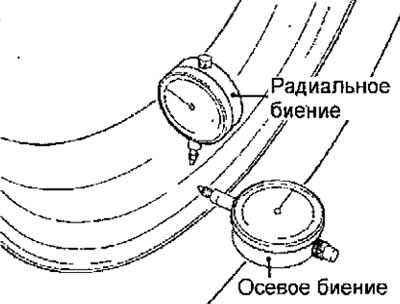
Fig. 14.79. Using a pointer indicator to measure wheel runout
3. Replace the wheel if the wheel runout exceeds the maximum permissible value.
Maximum permissible wheel runout:
- Radial runout of steel wheel disk: no more than 1.2 mm
- Radial runout of aluminum wheel disk: no more than 1.0 mm
- Axial runout of steel wheel disk: no more than 1.2 mm
- Axial runout of aluminum wheel disk: no more than 1.0 mm