



Draining the coolant
The vehicle must be on a level surface. Drain the coolant as follows:
If the engine is cold, unscrew the radiator cap and expansion tank cap. If the engine is hot, slightly unscrew the cap, wrapping it with a rag to avoid scalding yourself with steam, and wait until the pressure in the system drops. If you unscrew the cap quickly when the engine is very hot, the pressure drop will cause the liquid to boil. After the pressure drops, unscrew the cap.
If antifreeze is in the radiator, drain it into a clean container for reuse.
Open the interior heater tap.
Open the drain cocks at the bottom of the radiator tank and on the cylinder block (if any).
When the liquid stops flowing, clean the drain holes with a short piece of wire - they may be clogged with rust or scale particles.
CAUTION: If you open the drain cock only on the lower radiator hose, the fluid will not flow out of the cylinder block.
Over time, the radiator becomes clogged with rust and scale. To flush the system, unscrew and remove the upper and lower hoses. Insert the hose into the upper neck of the radiator and flush it with water for 10-15 minutes.
If you suspect that the system is clogged, pour a solution of one of the special cleaning agents that are available on the market into it. Check that the agent is compatible with the aluminum cylinder head.
Filling the cooling system
When filling the system, use distilled water mixed with antifreeze in the right proportion. Using distilled or rain water significantly reduces the rate of deposit formation.
The following order of filling the system is recommended:
Unscrew the bleed plug (arrow) or disconnect the hose from the intake manifold heater unit and open the heater valve.
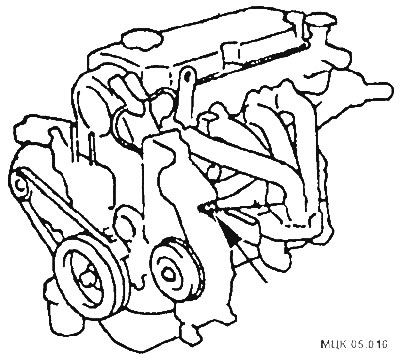
Pour coolant into the radiator until it starts to come out of the plug hole or the disconnected hose. Tighten the plug (1).
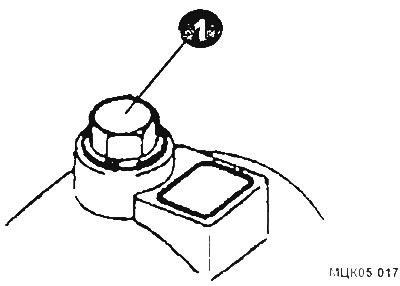
Place the hose on the heating unit fitting and secure it with a clamp, without stopping pouring liquid into the radiator to prevent an air lock from forming.
Warm up the engine. Warming up the engine is necessary to remove air bubbles from the system. If the system is filled to the required level at operating temperature, then when cooling down it will be necessary to top up, since when cooling down the volume of liquid will decrease by about 250 cm³. Check the liquid level again when the engine is hot. Add liquid to the expansion tank to the "FULL" mark.