



Contents: Checking the coolant temperature…⤓ Checking the coolant temperature…⤓ Checking the injection system…⤓
Petrol engines are equipped with 2 temperature sensors, diesel engines have one dual temperature sensor. They consist of an NTC element (NTC - negative temperature coefficient), the resistance of which decreases with increasing temperature. In a petrol engine, both sensors are installed in the thermostat housing. From the single-pole sensor, temperature information is transmitted to the temperature gauge on the dashboard. If the sensor is faulty, the gauge does not show at all or gives incorrect readings. The signal from the dual-contact temperature sensor goes to the fuel injection device control unit.
In a diesel engine, the signal from contact 1 goes to the coolant temperature gauge, and from contact 2 to the glow plug system.
Checking the coolant temperature gauge sensor
Disconnect the connector from the temperature sensor.
Turn on the ignition and watch the temperature gauge.
Touch the sensor connector to ground, the pointer should be in the extreme maximum position. If the pointer does not indicate the maximum reading, you should check the correct installation and contacts of the sensor connector, also check the electrical wires and connection points on the dashboard according to the electrical diagram. If there is a maximum reading, remove and replace the sensor.
To prevent coolant from leaking out when removing the sensor, it should first be partially drained and collected.
Apply sealant to the sensor threads.
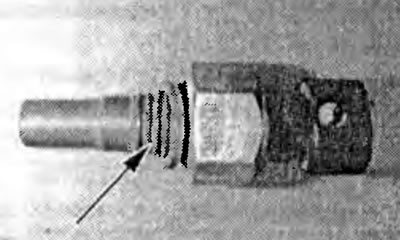
Secure the temperature sensor with a force of 10 Nm, put on the connector.
Add coolant.
Take a test drive and check the temperature sensor connection for leaks.
The text of the article was taken from the website MitsubishiMan.ru
Checking the coolant temperature sensor when removed
Disconnect the connector and unscrew the temperature sensor.
Connect an ohmmeter and warm up the temperature sensor in a water bath.
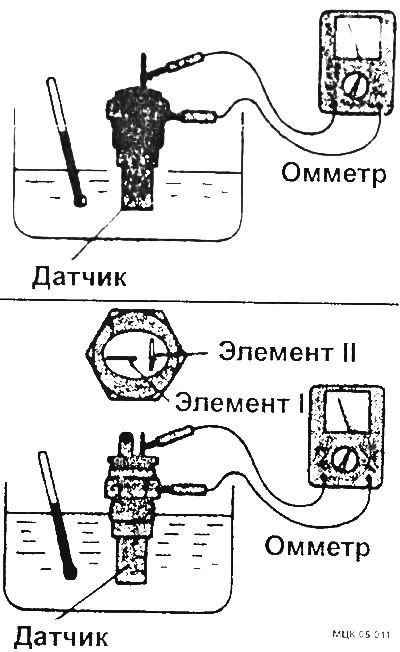
Required values for gasoline engines:
- at 70°C: 104±13.5 Ohm;
for diesel engines:
- at 70°C 104±13.5 Ohm (element I);
- at 20°C: 3.25±0.33 Ohm (element II).
Apply sealant to the temperature sensor threads.
Secure the sensor with a force of 10 Nm and 30 Nm for diesel engines. Put on the connector.
Add coolant.
Take a test drive and check the temperature sensor connection for leaks.
Checking the injection system temperature sensor
Disconnect the connector and unscrew the temperature sensor.
Connect the ohmmeter and warm up the temperature sensor in a water bath.
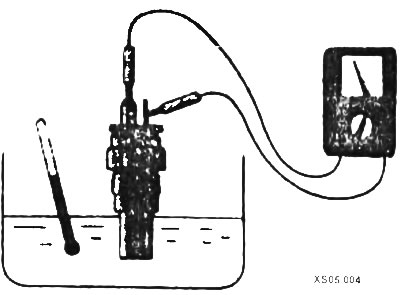
Required values:
- 2.45±0.24 kOhm at 20°C;
- 296±32 Ohm at 80°C.
Apply sealant to the temperature sensor threads.
Secure the temperature sensor with a force of 30 Nm, put on the connector.
Add coolant.