
English Русский
Български
Беларускі
Український
Српски
Hrvatski
Română
Polski
Slovenský
Magyar
Articles Bookmark Contacts Sitemap   
Company Audi Company Ford Company Hyundai Company Kia Company Mazda Company Mercedes-Benz Company Nissan
MitsubishiMan.ru


Home Colt Lancer Galant L200 Outlander Pajero Others
Colt 5 (1995-2003, petrol) Colt 4 and 5 (1991-2003) Colt 2 and 3 (1983-1993)

Cooling System Hoses — Maintenance and Repair (Mitsubishi Colt 4)

  • Home
  • Colt
  • 4 (1991-2003)
  • Power unit
  • Cooling system
  • Cooling System Hoses — Maintenance and Repair
0


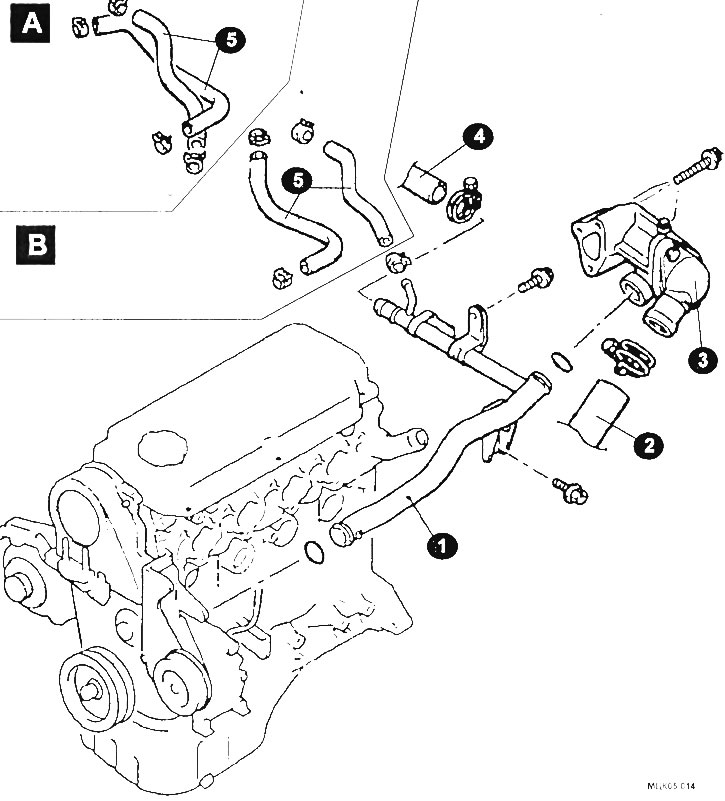
Coolant line components
1 - cooling system pipeline; 2 - lower radiator hose; 3 - thermostat housing; 4 - heater hose; 3 - hoses; A - DOHC models; B - SOHC models.


Coolant hoses are the most abused components of any car. However, careless owners are often surprised when a hose ruptures or otherwise fails. Hoses age and become stiff and cracked over time. They are exposed to high temperatures and pressures of up to 1.5 kg, cm during normal operation. Their worst enemy is oil. If it gets on the hose, it should be wiped off immediately. If the hoses are not properly secured, they will rub against surrounding components, eventually causing pinholes.

When checking the oil and electrolyte levels, also inspect the cooling system hoses. Check the tightness of the clamps every three months or after a long period of fast driving. If the clamps cut too deeply into the hoses, move the clamp along the hose or replace the hose. If the hose becomes stiff or cracks begin to develop, replace it immediately.

If a hose ruptures, stop the engine as soon as possible. Carefully open the hood (there may be a stream of hot coolant under the hood). As soon as possible, throw a piece of thick cloth over the rupture. Place another piece of cloth over the radiator/expansion tank cap and twist it to relieve the pressure. This will reduce the flow and allow you to pinpoint the problem more accurately. If the problem is with one of the small hoses, it may be possible to short-circuit the rupture. If one of the larger hoses has ruptured, surgical tape or electrical tape can be used as a temporary measure. A more drastic temporary measure is to cut the hose at the rupture and insert a piece of metal tubing, securing the hose with two hose clamps. This device will hold the fluid well until you can install a new hose.


Never pour cold water into a hot engine if it is not running: this is the surest way to cause cracks in the cylinder head. If there is enough coolant in the system, you can pour cold liquid, adding it to the hot one.

Finally, if a hose bursts, you need to find out the cause before taking any action. The burst may be due to the hose being old or neglected. In this case, nothing more than replacing the hose is required. However, if it was a new hose, the cause should be found out immediately.

How to distinguish low-quality hoses


Both upper and lower radiator hoses have to work hard in adverse conditions. They are subjected to pressures of up to 1.5 kg/cm and temperatures of over 100°C, and must pass around 30,000 litres of coolant per hour - so it is important to keep an eye on their condition.

Swollen hose


A good test for a hose is to feel it for softness and porosity. Often these defects will show up as swollen spots on the hose. The most likely cause is exposure to oil. A hose can burst at any time when it is hot and under pressure.

Cracked hose


Cracked hoses appear because usually the hoses are simply inspected, but not felt to see if they are solid.

Wear of the hose end (due to weak clamping)


Loose clamps are often the cause of damage to coolant hoses. The tube-to-hose connection wears out, causing fluid to leak out when the engine is hot.

Dirt in the cooling system


Dirt, rust and scale in the cooling system will cause wear on the inside of the hose. This can be felt on the outside as a soft or thin spot.
This article is available at: russian, bulgarian, belarusian, ukrainian, serbian, croatian, romanian, polish, slovak, hungarian
This article was reviewed by: Nikita Romanov
Share with friends:
◀ Previous
Colt 4 and 5: Cooling system
Next ▶

Antifreeze and corrosion inhibitors — general information
Expansion tank — removal and installation
Troubleshooting on the road
Coolant Temperature Sensor — Removal, Installation and Testing
Electric Fan — Removal and Checking
Diagnostics of cooling system faults
Similar materials for other Mitsubishi models

➤ Hoses and tubes of the cooling system Mitsubishi Lancer 9 (2000-2007, petrol)
➤ Cooling system maintenance Mitsubishi Galant 6 and 7 (1987-1998)
➤ Inspection of lubrication system hoses and vacuum pump Mitsubishi L200 4 (2005-2014, diesel)
➤ Recommendations for engine maintenance and repair Mitsubishi Outlander 1 (2003-2008)
➤ Cooling system hoses Mitsubishi Pajero 1 and 2 (1982-1999)
➤ Cooling system hoses and pipes — removal and installation Mitsubishi Carisma (1995-2004)
Link in different formats to this article
Comments and feedback from visitors
No comments yet


Add up two numbers 43 + 25


Colt 5 (1995-2003, petrol) 
  • General information
  • User manual
  • Specifications
  • Gasoline engines
  • 4G1 engines until 1995
  • 4G1 engines since 1995
  • Repair of 4G9 engines
  • Cooling system
  • Reduced exhaust gas toxicity
  • Engine electrical equipment
  • Injection system MPI
  • Carburetors
  • Transmission
  • Clutch and drive shafts
  • Manual gearbox F4M21/F5M21
  • Manual gearbox F4M41
  • Automatic gearbox F4A21
  • Automatic gearbox F4A41
  • Chassis and running gear
  • Car suspension
  • Steering
  • Brake system
  • Body
  • Exterior (external elements)
  • Electrical equipment
  • Equipment and devices
  • Electrical circuits
Colt 4 and 5 (1991-2003) 
  • General information
  • Maintenance
  • Power unit
  • Engine in a car
  • Engine repair (gasoline)
  • Engine repair (diesel)
  • Lubrication system
  • Cooling system
  • Carburetor
  • Fuel injection MPI
  • Fuel injection GDI
  • Emission reduction
  • Fuel system (diesel)
  • Ignition system
  • Exhaust system
  • Transmission
  • Clutch
  • Manual gearbox
  • Automatic gearbox
  • Drive shafts
  • Chassis and running gear
  • Chassis malfunctions
  • Front suspension
  • Rear suspension
  • Steering
  • Wheels and tires
  • Brake system
  • Body and interior
  • Body elements
  • Electrical equipment
  • Equipment and devices
  • Power devices
  • Heating and air conditioning
  • Electrical circuits
Colt 2 and 3 (1983-1993) 
  • General information
  • User manual
  • Daily care
  • Maintenance
  • Power unit
  • Engine in a car
  • Engine overhaul
  • Cooling system
  • Heater and air conditioner
  • Power and exhaust system
  • Engine electrical equipment
  • Emission reduction
  • Transmission
  • Mechanical gearbox
  • Automatic gearbox
  • Clutch and axles
  • Chassis and running gear
  • Brake system
  • Car suspension
  • Steering
  • Body and interior
  • Body and elements repair
  • Electrical equipment
  • Equipment and devices
  • Electrical circuits
MitsubishiMan.ru © 2018–2026 • Mobile version • Articles about Mitsubishi • Contacts • Sitemap: EN BG BY UA RS HR RO PL SK HU • Site search • Bookmark
Colt 2 and 3 (1983-1993) · Colt 4 and 5 (1991-2003) · Colt 5 (1995-2003) · Lancer 3 and 5 (1984-1992) · Lancer 9 (2000-2007) · Galant 5 (1983-1989) · Galant 6 and 7 (1987-1998) · L200 4 (2005-2014) · Outlander 1 (2003-2008) · Pajero 1 and 2 (1982-1999) · Pajero 4 (2006-2021) · Carisma (1995-2004) · Space Star (1998-2005) ·
This resource sets cookies 🍪 to avoid bothering you with repeated data entry.