



Contents: Condition of main bearings and main…⤓ Condition of connecting rod bearings…⤓ Camshaft bearings and camshaft…⤓ Condition of oil line plugs and oil…⤓ Knocking of main bearings ⤓ Knocking of connecting rods ⤓ Valve knocking ⤓ Camshaft wear ⤓ Low compression ⤓ Never use low quality parts ⤓ Oil leaks ⤓ Oil burnout ⤓
There are several reasons why oil pressure may be low, which will require an engine overhaul. If you decide to overhaul your engine due to low oil pressure, pay special attention to the following when disassembling:
- condition of main bearings and main journals of the crankshaft;
- condition of connecting rod bearings and crankshaft journals;
- clearance in camshaft bearings and camshaft journals;
- condition of the oil line plugs and condition of the oil line.
Condition of main bearings and main journals of the crankshaft
Damaged main bearings can cause a decrease in oil pressure or even a dull thumping sound. The sound will resemble a high-pitched thumping sound. Replacing main bearings is part of any engine overhaul.
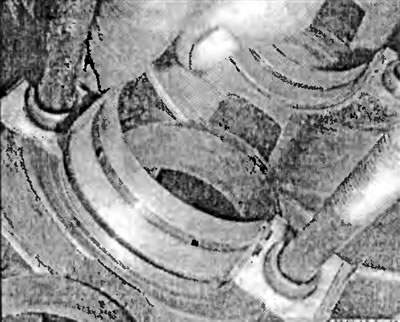
When the main bearings and/or main journals of the crankshaft are worn, the clearance between the bearing (liner) and the journal increases. The increase in clearance allows oil to easily escape from the space between the bearing and the journal. This oil escape causes a decrease in oil pressure. The method for eliminating this malfunction is to grind the crankshaft and/or replace the crankshaft and bearing liners.
Condition of connecting rod bearings and connecting rod journals
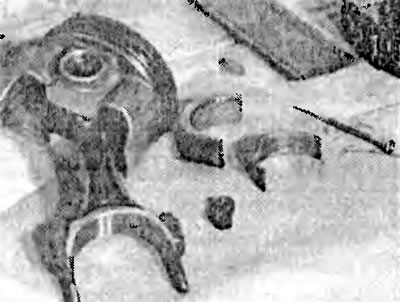
Bad connecting rod bearings cause dull knocking sounds, some higher in pitch than main bearing knocks but lower in frequency. Rod bearing knocking only occurs when the working mixture in the combustion chamber is ignited. Main bearing knocking occurs every time a spark jumps in a spark plug (petrol engines) or fuel is injected from an injector (diesel engines).
Like main bearings and main journals, connecting rod bearings and journals can cause a drop in oil pressure if the clearance between them increases significantly. A noticeable increase in clearance allows engine oil to easily escape from the space between the bearing and the crankshaft journal. The oil escapes causing a drop in oil pressure. The only way to fix this problem is to regrind or replace the crankshaft and replace the bearings.
Camshaft bearings and camshaft journal clearance
Often overlooked by inexperienced repairers, excessive clearance between the camshaft journals and camshaft bearing can also cause low oil pressure, just as large clearances in the connecting rod or main bearings can. It is sometimes believed that because camshaft bearings are not subject to the same stresses as connecting rod and main bearings, they require no more than a simple visual inspection. Nothing could be further from the truth. On most overhead cam engines, camshaft bearings are virtually impossible to replace without completely disassembling the engine. Repairing an engine without thoroughly inspecting the bearings and camshaft journals runs the risk of the rebuilt engine still suffering from low oil pressure. Always inspect the bearings and camshaft journals thoroughly.
Condition of oil line plugs and oil line itself
If the oil passages are clogged with deposits from poor maintenance or if the plugs at the ends of the oil passages are leaking, the engine will suffer from low oil pressure. When rebuilding an engine, take the block and cylinder head to a shop and have them hot cleaned. This ensures that the oil passages are clean and the oil can flow freely.
Knocking of main bearings
Not only does increased bearing clearance cause low oil pressure, but low oil pressure is usually accompanied by a knocking sound. This knocking sound is a high-pitched, high-frequency sound coming from deep within the cylinder block. The term "high-pitched" refers to the musical pitch of the knocking sound. The term "high-frequency" refers to the number of knocks that occur during one engine cycle. If the knocking frequency is about the same as the number of cylinder firings, the main bearings require attention.
You can avoid wasted time and effort by analyzing a sample of engine oil. Some shops will analyze a sample of engine oil from your engine. The results will tell you how much bearing and crankshaft material is in the oil. If the amount of these materials is high, it indicates that the engine needs to be rebuilt.
Knocking of connecting rods
The knock of connecting rods can be very similar to the knock of main bearings. Its tone can vary from higher than that of main bearings to lower. The main difference is a lower repetition rate. This is because a specific connecting rod, unlike a main bearing, is subjected to load (high pressure) only when a flash occurs in the corresponding cylinder. The frequency of connecting rod knocking will correspond to one knock per one engine cycle. This is explained by the fact that the cylinder with a faulty connecting rod works only once per one engine cycle.
The problem with analyzing bearing knock by sound remains difficult to solve until you are very familiar with the engine you are working on and can say to yourself, "Is this high pitched or low pitched, high frequency or low frequency bearing knock different from the knock that comes from another component if it is faulty?".
Valve knocking
Many engines have manually adjustable valves. On these engines, valve noise can often be eliminated by adjusting the valve clearances. Even on engines with hydraulic valve lifters, valve knocking does not always require an engine overhaul. There is a belief that major valve repairs cause the piston rings to lose their sealing ability. As with the other beliefs, there is an element of truth to this. When the valves' sealing ability increases, the pressure in the combustion chambers increases so much that it becomes close to what it was when the engine was new, and the piston rings are no longer new. They begin to leak compression pressure. The result is that the valves seem to be causing the piston rings to deteriorate. What is happening is that the rings have now replaced the valves as the weakest link in a chain.
The takeaway from the above is that if an engine has enough wear to require valve grinding, it probably needs a major overhaul. This is a pretty bold statement, and in some cases, no overhaul is required, such as when a valve rocker arm has failed due to a manufacturing defect.
Camshaft wear
Some engines have chronic problems with camshaft lobe wear.
Sometimes this is because the camshaft designers chose the wrong material. Often camshaft failures are the result of poor maintenance or lack of lubrication.
Before deciding whether worn camshaft lobes will require a complete engine rebuild or whether a simple replacement of the camshaft and valve lifters (if any) will suffice, consult with an auto repair shop. If this type of engine has a reputation for being prone to such cam failure, then replacing the camshaft is probably the best option. On the other hand, if the engine is not prone to this type of failure, then a worn camshaft lob may be an indicator of another underlying problem; the engine needs to be repaired.
Low compression
As an engine wears over time, the ability of each cylinder to withstand and create pressure decreases. This can be due to several factors. First, the valves no longer seal as well as they did when the engine was new. After tens of thousands of miles, the piston rings do not seal as well as they did when the engine was new. Over time, the cylinders become slightly oval in shape, and the piston rings no longer seal as well as they used to. When an engine reaches this state, it is considered "tired.".
Low compression in one of the cylinders is usually the result of one of two defects.
One is a burnt, bent or poorly sealing valve. Another is a damaged head gasket. The best way to differentiate between these faults is to use a cylinder leak indicator.
Low compression in one of the cylinders is usually the result of damage to one of the components.
Never use low quality parts
Always check carefully for additional damage when performing the main work. A catastrophic failure of one part can cause failure of other parts. It can also be an indicator of other nearby failures.
Oil leaks
Relatively new engines do not require a major overhaul simply because small oil leaks are found on the garage floor. However, older engines may have so many leaks that the only practical and logical way to repair it is to remove and rebuild it. When an owner decides to remove the engine to fix the leaks, it makes sense to overhaul the engine.
Oil burnout
Two malfunctions can cause excess oil to burn - oil penetration past the piston rings and past the valve guide bushings. Each malfunction has its own symptoms and remedies.
Oil penetration past the piston knees
The most common symptom associated with piston rings that are wearing out and allowing oil to pass past them is blue smoke when accelerating. Before you suspect the rings, there are a few other things to check.
(The text of the article was taken from the website: «mitsubishiman»)
If the crankcase pressure is too high, it can force oil past the piston rings and into the combustion chamber. If the crankcase pressure is too low, oil can flow into the intake tract. When either of these occurs, the oil is burned when the air-fuel mixture ignites. Although these symptoms are identical to those of worn piston rings, this problem is fairly easy to fix.
Engines are equipped with a Positive Crankcase Ventilation (PCV) system. The purpose of this system is to capture hydrocarbon containing gases that pass past the rings from the combustion chamber and direct them back into the combustion chambers for re-burning. When the PCV system becomes clogged, the crankcase pressure in the engine begins to drop. This drop in pressure is a result of the intake manifold vacuum pulling gases out of the crankcase and air not replacing the gases in the crankcase due to the clogged PCV system. The result is that as the pressure drops, the intake tract pulls in increased amounts of oil through the vent system. If the PCV valve itself is clogged, the crankcase pressure increases and oil passes past the oil scraper rings during the intake stroke.
Another common cause of oil burnout, somewhat similar to oil passing past the piston rings, is a stuck or "sticking" oil scraper ring. A "sticking" ring can often be freed with a high-detergency oil. Also, a large number of oil additives can clean piston rings. Consult with your auto repair shop regarding which oil to use for these purposes.
Oil penetration through valve guides
If blue smoke comes out of the exhaust pipe when engine braking, it is probably the result of worn valve guides. When engine braking, the pressure in the intake manifold drops significantly and the vacuum increases. The higher vacuum causes the combustion chamber to empty. Excessive clearance between the valve stem and the guide allows the combustion chamber vacuum to pull air from the top of the cylinder head, under the valve cover. This air is saturated with oil. The oil is pulled in along with the air and burned in the combustion chamber.
A fault involving oil in the valve guides is easily fixed without a major engine overhaul. However, the piston rings, main and connecting rod bearings, camshaft and camshaft bearings may also be as worn as the valve guides. You need to see if you are simply trying to fix the symptom or if you are making the engine capable of running for tens of thousands of miles.