



Contents: Identification of knocks and noises ⤓ Smoke analysis ⤓ Checking the PCV (Exhaust Gas…⤓ Checking with a vacuum gauge ⤓ Checking for leaks in cylinders ⤓
Identification of knocks and noises
There is no need to determine exactly which part of the engine is responsible for the knocking, your chain is simply to determine if there are any faults in the main engine parts that could be the cause of the sound you hear. If the knocking part is a main engine part, then it does not matter which part, the repair in all cases is the same - an engine overhaul.
Car enthusiasts use three devices to find a possible source of knocking in a car: high-voltage wires, a stethoscope and a rubber hose.
Spark plug high voltage wires
With the engine idling, disconnect and then reconnect each spark plug wire one at a time. If the knocking noise changes in intensity when one spark plug wire is disconnected, the knocking noise is coming from the connecting rod bearing. If the noise does not change much, it is probably the result of a bad main bearing or something else. Don't forget about things like valve adjustment.
Stethoscope
A mechanic's stethoscope has the ability to detect engine noises. Place the end of the stethoscope on the engine block or cylinder head where the suspect component is located. When a sound is detected with the stethoscope, move the end of the stethoscope around the area until the sound is the loudest. The component closest to the area where the loudest sound is detected is most likely the one with the problem. Keep in mind, however, that sound can be transmitted from one area to another through metal.
Rubber hose
If you don't have a stethoscope, use a piece of rubber tubing. It doesn't work as well as a stethoscope, but it will work.
Smoke analysis
Three noticeable smoke colors are used in engine diagnostics: black, white and blue.
Black
Black or dark brown smoke is usually associated with an engine that is running too rich. Although the air/fuel ratio can affect engine health, especially on fuel-injected engines, engine repair is a last resort to reduce smoke. Refer to the fuel injection repair information for more information.
White
White smoke has two common causes: transmission fluid and antifreeze (coolant). If the vehicle has an automatic transmission, look at the vacuum modulator. The vacuum modulator is usually located at the rear of the transmission (transmission) near the output shaft housing. It is easy to identify because the vacuum hose goes into it. Remove the vacuum hose and check for transmission fluid in the hose. If you find transmission fluid in the hose, replace the vacuum modulator, this is the most likely source of white smoke.
If you do not find any transmission fluid in the vacuum hose, or the vehicle is not equipped with an automatic transmission or does not have a vacuum modulator, the most likely source of the white smoke is a bad head gasket, a cracked head, or the cylinder block itself. These problems can be confirmed with a compression test or, better yet, a cylinder leak test. See below for details on using a cylinder leak finder.
The original article is on: www.mitsubishiman.ru
It is fairly easy to determine whether white smoke is the product of transmission fluid or coolant burning. Coolant has a sweet smell, while transmission fluid has a smoky smell.
Blue
Blue smoke indicates engine oil combustion. Pay attention when smoke comes from the exhaust pipe. If smoke appears during acceleration, then its source is worn piston rings. If it appears during engine braking, then pay attention to the valve guides.
Checking the PCV (Exhaust Gas Recirculation) System
Crankcase pressure can affect whether or not intake manifold vacuum pulls engine oil into the intake manifold. Check the PCV system before deciding to rebuild the engine due to a smoking problem.
You can take one of two possible routes to check the PCV system. One route is to replace the PCV valve and check the vent hose for blockages. A more sophisticated approach is to purchase a special PCV tester from an auto parts store that fits over the PCV vent hose to determine if the crankcase pressure is within the proper range. Of course, if the pressure is incorrect, you will need to replace the PCV valve and check the vent hose for blockages.
Checking with a vacuum gauge
A vacuum gauge is a useful tool for diagnosing timing and camshaft problems. Any of these problems will cause manifold pressure pulsation (this can be seen by the jumps in the gauge needle). However, manifold pressure pulsation can be caused by ignition system problems or piston problems. A vacuum gauge should only be used to confirm the presence of a problem, not to indicate the problem.
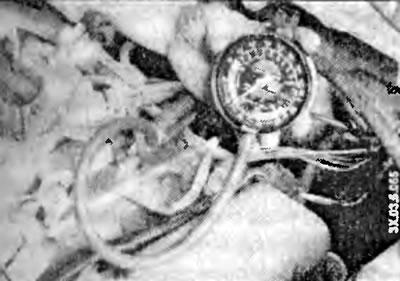
Using a vacuum gauge is an easy way to begin to separate low compression problems as being the result of piston ring or head gasket failures, or as being the result of valve failures. With the engine idling, connect a vacuum gauge to the intake manifold. If the vacuum gauge needle bounces wildly back and forth, then some valves are not sealing properly. Low compression due to piston ring or head gasket failures will also cause the needle to bounce, but not as wildly.
Distinguishing between possible causes of low compression using a vacuum gauge requires a lot of experimentation and is highly subjective. Two other methods are compression testing and cylinder leak testing.
Checking for leaks in cylinders
Checking cylinders for leaks is a higher level test than checking compression, although its purpose is the same. It requires more equipment. With the piston at TDC on the compression stroke, attach a cylinder leak tester to cylinder number one. Measure the percentage of leaks. Additionally, use a piece of rubber hose and place one end to your ear to determine where the leak is. Insert the other end of the hose into the open hole in the throttle body of the fuel injection system. If a lot of air comes out, you have a bad intake valve. If you hear a hissing sound from the exhaust, the exhaust valve is bad. Look at the coolant in the radiator. If there are a lot of bubbles, you have a bad head gasket, a crack in the head, or a crack in the block itself.