



CAUTION: The engine must be at normal operating temperature and the battery must be fully charged when performing the check.
Start by cleaning the area around the spark plugs before you remove them to prevent dirt from getting into the cylinders when you perform the compression test. If you have a source of compressed air, you should use that for this purpose, but a soft brush or even a regular bicycle pump will also work.
Remove all spark plugs from the engine.
Lock the throttle valve in the fully open position.
Remove the ignition coil wire from the center terminal of the distributor.
Insert the compression tester tip.
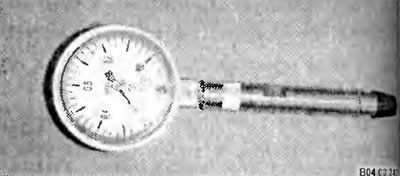
Compression tester for gasoline engines
Rotate the engine shaft with the starter for at least seven compression strokes, monitor the sensor readings. The pressure should build up quickly in a serviceable engine. Low pressure during the first stroke, accompanied by a gradual increase in pressure during subsequent strokes, indicates worn piston rings. Low pressure during the first strokes, which does not increase during subsequent strokes, may be due to leaks in the valves or a damaged cylinder head gasket (a crack in the head may also be the cause). Low pressure may be caused by deposits on the valve heads. Record the pressure values obtained.
Repeat this operation for the remaining cylinders and compare the measurement results with the technical data.
Add a little motor oil into each cylinder through the spark plug hole and repeat the measurements.
If the pressure increases after adding oil, the piston rings are certainly worn. If the pressure has not increased significantly, the leak is at the valves or cylinder head gasket. Valve leaks can be caused by burnt valve seats and/or valve faces, or cracked, warped, or bent valves.
If the pressure in two adjacent cylinders is low, there is a good chance that the cylinder head gasket between them is damaged. The appearance of coolant in the combustion chambers or crankcase supports this assumption.
If the pressure in one cylinder is approximately 20% lower than in the others and uneven engine operation is felt at idle, then the cause of this may be a damaged exhaust cam on the camshaft.
If the pressure is unusually high, it is possible that the combustion chambers are coated with carbon deposits. If so, the cylinder head will need to be removed and cleaned.