



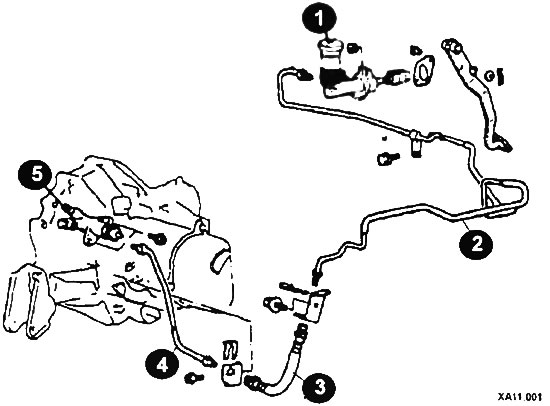
Hydraulic clutch drive elements
1 - clutch master cylinder; 2, 4 - hydraulic tube; 3 - hose; 5 - clutch slave cylinder.
The transmission of force between the engine and the gearbox is carried out by means of a clutch, which works using friction. Two adjacent surfaces clamp a third and hold it so tightly that it rotates together with these surfaces. The meaning of this is that this connection can be opened at any time. The flywheel and the pressure plate with the spring are firmly connected to the engine. Between them is clamped the driven disk of the clutch, which is connected by a splined connection to the shaft of the gearbox.
Another important function is performed by the clutch release bearing: when the clutch pedal is pressed, it presses the pressure plate under the action of the clutch drive mechanism and overcomes the force of the pressure plate spring. The driven disk is then released from its forced clamped position and can rotate freely between the pressure plate and the flywheel. The engine and gearbox are disconnected.
The clutch drive is hydraulic. The clutch is single-disk, dry, with a diaphragm spring.
The clutch disc moves freely along the splined gearbox input shaft and is positioned between the flywheel and pressure plate when the pressure plate spring is pressed. The friction linings are riveted to the clutch disc and have a spring-loaded lining to absorb gearbox vibration and improve power take-off.
The text of the article was obtained from the website: mitsubishiman.ru