



Contents: Moving uphill ⤓ Downhill movement ⤓ Position of the gear selector lever ⤓ Gear shift lever positions ⤓
The electronically controlled automatic transmission, designed for optimum vehicle control and capable of adaptive control, ensures optimum gear shifting to suit almost all driving and road conditions.
Moving uphill
The transmission may not shift up if the computer determines that the vehicle will not be able to maintain the same speed when shifting up. To ensure smooth vehicle operation, if you release the accelerator pedal while driving up a steep hill, the transmission may not shift up. This is normal because the computer temporarily prevents the transmission from shifting. Normal shifting is resumed after reaching the top of the hill.
Downhill movement
When driving down steep slopes, the computer can automatically select a lower gear. This function increases the braking effect of the engine and thus reduces the need to use the brakes.
(The article was taken from the website: «MITSUBISHIMAN.ru»)
Position of the gear selector lever
The automatic transmission has four forward gears and one reverse gear. The gear is selected automatically depending on the position of the gear selector lever, the vehicle speed and the position of the accelerator pedal. The gear selector lever has 7 positions and is equipped with a locking button to prevent accidental engagement of the wrong gear.
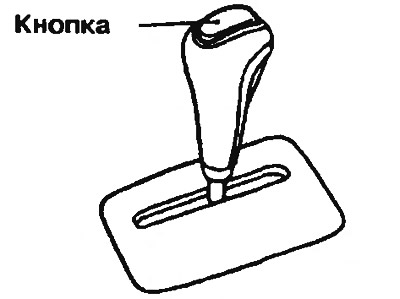
 To move the gear selector lever, you need to press the button.
 You do not need to press the button to move the gear selector lever.
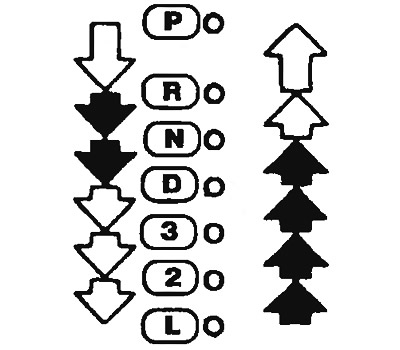 | 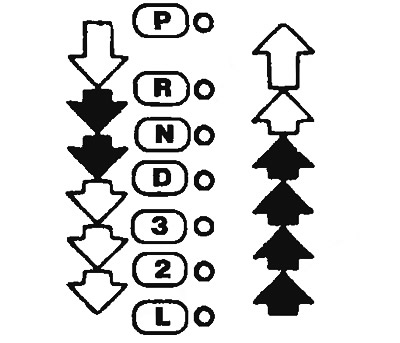 |
Indicator lights on the instrument panel show the position of the gear selector lever, and one of them lights up when the ignition is turned on.
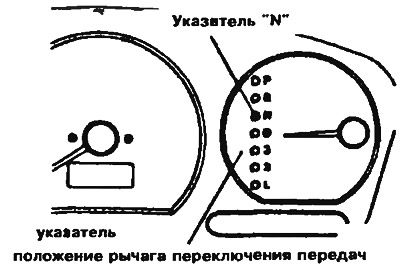
If the "N" light on the gear selector lever position indicator flashes, this indicates a malfunction in the automatic transmission.
If the "N" light flashes at a high frequency (twice per second) when the lever is in the "D", "3", "2" or "L" position, the automatic transmission fluid is overheated.
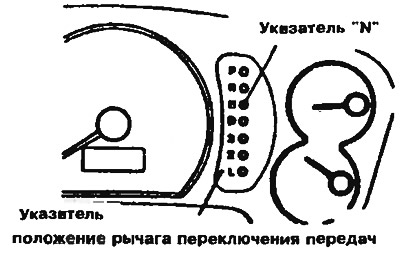
Stop your car in a safe place, but do not turn off the engine. Move the gear selector lever to position "P" and open the hood. Leave the engine idling. After a while, move the gear selector lever to position "D", "3", "2" or "L" and make sure that the "N" light stops flashing. If the light no longer flashes, you can continue driving. The "N" indicator light only works when the lever is in the specified positions.
Gear shift lever positions
R - parking
In this position, the gearbox is locked, preventing the car from moving. In this position, the engine can be started.
Warning! Never engage the "P" (park) position while the vehicle is moving. Shifting the lever to the "P" or "R" position while the vehicle is moving may damage the transmission.
R - reverse
Move the lever to this position only after the vehicle has come to a complete stop.
N - neutral position
In this position, the transmission is disengaged. It is similar to the neutral position of a manual transmission and should be used when the car is stopped for a long time during a trip, for example, in traffic jams.
Warning! Never set the lever to the "N" position while driving, as engine braking will be impossible. When parking on a slope, the engine should be started with the lever in the "P" (parking) position, not "N" (neutral).
D - forward movement (gears are switched automatically)
This position is used for driving in the city and on the highway, from a complete stop to maximum speed. If necessary, in appropriate road conditions, engine braking is automatically activated.
3 - third/2 - second gear
This position is used to create additional power when driving downhill on a moderate incline and for engine braking when driving downhill on a moderate incline.
L - low gear
This position is used when driving downhill on a steep incline or for engine braking at low speeds while descending a mountain.
Caution! This position can be used for maximum engine braking. Avoid sudden engagement of the "I" gear. Sharp engine braking may cause skidding. Engage this position based on road conditions and vehicle speed.