



2. High mileage does not necessarily indicate the need for an overhaul, just as low mileage does not exclude the need for an overhaul. The most important indicator is the frequency of maintenance. Regular and frequent oil and filter changes, as well as regular maintenance, usually ensure long-term reliable operation of the engine. Conversely, a neglected engine may very soon require an overhaul.
3. Increased oil consumption indicates that attention should be paid to the piston rings, valve seals and/or valve guides. Before concluding that the piston rings and/or guides are in poor condition, make sure there is no oil leakage. To determine the amount of work required, perform a compression test in the cylinders (see section 3).
4. Check the oil pressure with a pressure gauge installed in place of the oil pressure sensor (see illustration) and compare the measured value with the specification. If the pressure is too low, the bearings and/or the oil pump are worn. The location of the oil pressure sensor is shown in Illustrations 3.5a, 3.5b and 3.5c in Chapter 2A.
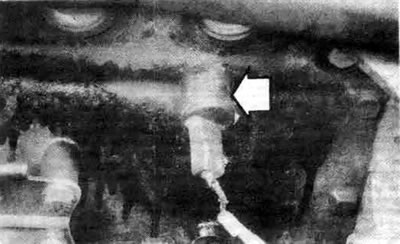
2.4a. Oil pressure sensor (arrow) under the exhaust manifold between the engine mounting bracket and the oil pump (1.5L engines)
[The original can be found on the website: www.MitsubishiMan.ru]
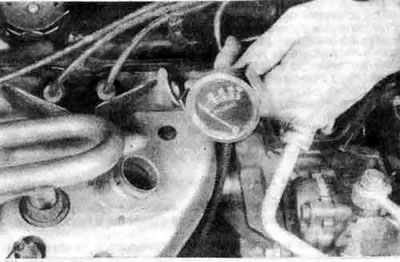
2.4b. The oil pressure gauge can be installed in the hole where the oil pressure sensor is usually located
5. Loss of power, hesitation, knocking or metallic sounds in the engine. Strong valve knocking and increased fuel consumption may also indicate the need for an engine overhaul, especially if all these signs appear at the same time. If a full adjustment does not eliminate these signs, then the only solution may be an overhaul.
6. An engine overhaul involves restoring the internal components to the parameters of a new engine. During an overhaul, piston rings are replaced and cylinder walls are restored (bored and/or honed). If the machine shop performs boring, then repair pistons are installed. Main bearings, connecting rod bearings and camshaft bearings are usually replaced with new ones and, if necessary, the crankshaft can be ground to restore the journals. Valves are also usually repaired, since at this point they are usually not in the best condition. During an engine overhaul, other components such as the ignition distributor, starter and generator can also be repaired.
Note: When overhauling the engine, it is necessary to replace important components of the cooling system, such as hoses, drive belts, thermostat, water pump. It is necessary to carefully check the radiator and make sure that it is not leaking or clogged (see Chapter 3). In addition, we do not recommend overhauling the oil pump - always install a new pump when overhauling the engine.
7. Before you begin rebuilding an engine, read the entire procedure carefully to understand the scope of work and any special requirements. Most of the work can be done with standard hand tools, but some parts require precision measuring instruments to determine the degree of wear. Since the condition of the engine block is the primary factor in deciding whether to rebuild an engine or purchase a rebuilt engine, do not purchase parts or repair units until the engine block has been fully inspected. In general, time is the primary cost of rebuilding, so do not install worn or substandard parts.
8. Finally, to ensure maximum service life and minimum hassle with your rebuilt engine, assembly should be done carefully and in a completely clean area.