



Contents: Removal ⤓ Installation ⤓
Most vehicles are equipped with a brake pad wear indicator. If you hear a characteristic squealing sound when using the brakes, check the wear of the pads. If the indicator touches the brake disc, the pads should be replaced.
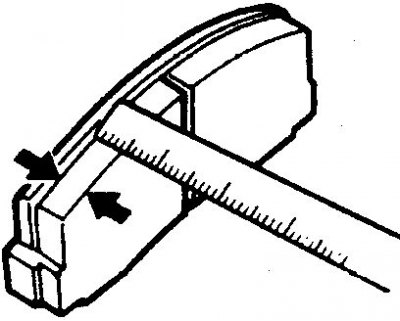
The remaining thickness of the pads can be checked through the window in the caliper for a more detailed inspection (uniformity of wear on the plane and checking the condition) the pads need to be removed. The maximum residual thickness of the pads is 2.0 mm.
Removal
1. Raise the front of the car and remove the wheel.
2. Remove some of the liquid from the tank.
3. Unscrew the lower pin, fold back the caliper and secure it. Do not allow the caliper pin protective grease to be removed or exposed to dirt.
4. Remove the pads, plates and brackets, remember the location of these parts.
Installation
1. Press the piston into the caliper cylinder using a clamp, monitoring the fluid level in the reservoir (when installing new pads, the piston should be retracted a significant distance).
2. Install the plates, brackets and new pads in the same order. If upper and lower brackets are provided, they should be replaced together with the pads.
[Article reprinted from the website MitsubishiMan.ru]
3. Install the caliper, wheel and lower the car.
4. Press the pedal several times to press the pads against the disc.
5. Check the fluid level and top up if necessary.
6. Start the engine and press the brake pedal several times again, check the pedal stiffness.
7. During the first 15 km of driving with new pads, avoid sudden braking.