



Conventional braking system (without ABS)
1. If air entered the system through the reservoir or when removing the master brake cylinder, it is necessary to bleed the brakes of all four wheels.
2. If the brake pipe was disconnected only on the brake of one wheel, it is necessary to bleed only the brake of that wheel.
3. If the brake pipe or hose has become disconnected between the master cylinder and any of the brakes, the brakes on those wheels must be bled.
4. Remove the vacuum from the power steering by depressing the brake pedal several times with the engine off.
5. Fill the reservoir with brake fluid.
6. Prepare new brake fluid, a clean container partially filled with brake fluid, a plastic tube and a wrench.
7. Starting from the left rear wheel, loosen the bleed screw, then tighten it lightly.
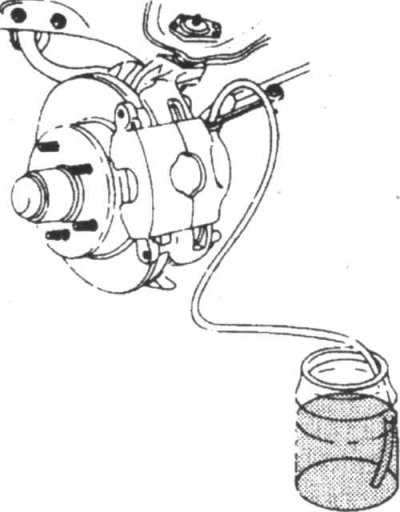
11.8 When bleeding the brakes the hose should be connected to the bleed screw and the other end should be lowered into the brake fluid - the escaping air will create bubbles - make sure all the air is removed before moving on to the next wheel
8. Place the end of the tube on the screw and lower the other end into the brake fluid (11.8).
9. Ask an assistant to press the brake pedal several times, then press the pedal all the way down.
10. When the pedal is depressed, open the bleed screw and wait for the brake fluid to drain. Close the screw.
11. Repeat this operation until no more air bubbles come out through the tube. Then tighten the bleed screw and bleed the brake of the right front wheel, right rear wheel and left front wheel. Monitor the fluid level in the reservoir.
12. Do not use old brake fluid.
13. Fill the reservoir with brake fluid after bleeding is complete.
14. Check the brakes. The pedal should be firm when pressed and not sink. If necessary, repeat bleeding.
Braking system with ABS
Attention! To bleed the brake system with ABS, the engine must be running. Raise the car and place it on reliable supports.
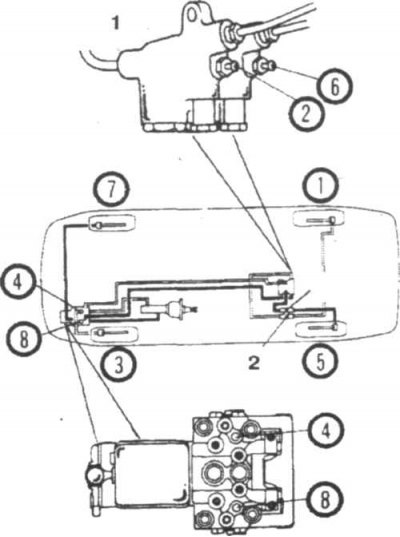
11.15 Observe the bleeding order (bleed screw No. refers to the left rear wheel brake, screw N6 - to the right rear wheel brake)
1. Delay valves; 2. Hydraulic modulator
15. Start the engine. Perform the operations described in points 8 and 10 and bleed the brake calipers and delay valves. Observe the bleeding order (11.15).
16. Remove air from the delay valve in the same way as from the brake calipers (11.15).
17. Tighten the bleed valve screws securely.
18. Bleed the hydraulic modulator located near the rear wall of the engine compartment (11.15).
19. Fill the reservoir with brake fluid after bleeding is complete.