



2. Remove the first connecting rod cover.
Checking the lubrication clearance of connecting rod bearings
3. Clean the new bearing and install it on the connecting rod. Do not lubricate the bearing yet.
4. Clean the second insert and install it into the lid.
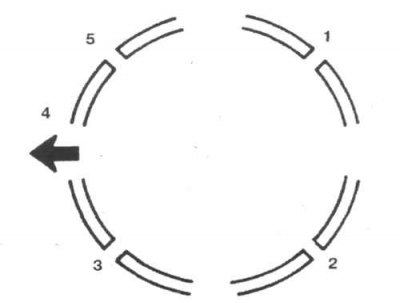
25.5 Turn the piston rings as shown in the figure before installing the pistons and connecting rods into the engine
1. First compression ring clearance; 2. Upper oil scraper ring clearance; 3. Clearance of the second compression ring and expansion ring; 4. To the crankshaft pulley; 5. Clearance of the lower oil scraper ring
5. Turn the piston rings so that their gaps are at an angle of 90° to each other (25.5).
6. Place the rubber hose sections onto the connecting rod bolts.
7. Lubricate the pistons and rings with clean engine oil and install the piston ring compressor onto the piston.
8. Turn the crankshaft so that the journal of the first cylinder is at the bottom dead center, and lubricate the cylinder walls.
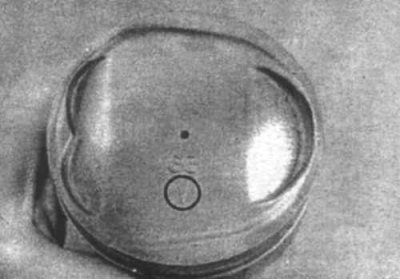
25.9 The mark on the piston head must face the timing belt
9. Check that the mark on the top of the cylinder (25.9) faces the timing belt, and install the piston and connecting rod into the cylinder so that the piston ring compressor touches the surface of the cylinder block.
10. Check that the ring compressor fits tightly against the cylinder block surface.
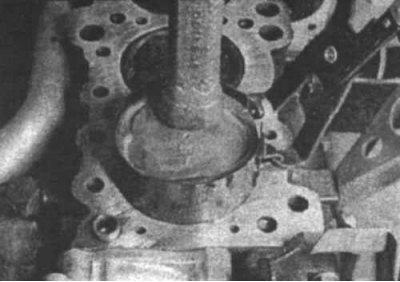
25.11 The piston can be lowered into the cylinder using a wooden handle
11. Tapping the piston with the handle of the hammer (25.11), lower the piston into the cylinder and install the connecting rod on the crankshaft journal.
12. Before final installation of the connecting rod cap, it is necessary to check the bearing lubrication clearance.
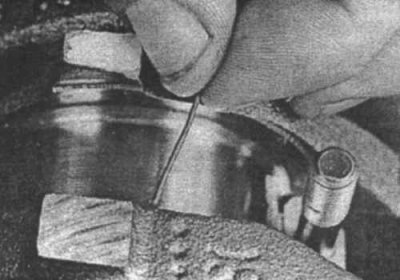
25.13 Place strips of Plastigodge film on each of the crankpins, parallel to the crankshaft axis
13. Cut a piece of Plastigodge film slightly shorter than the width of the connecting rod bearing and place it on the connecting rod journal, parallel to the crankshaft axis (25.13).
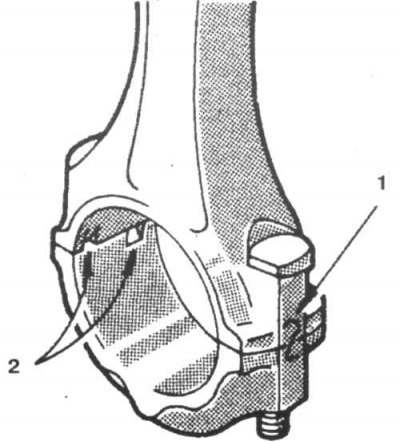
25.14 Align the numbers indicating the cylinder number and the projections on the bearing shell when installing the connecting rod caps
1. N cylinder; 2. Protrusions and grooves
14. Clean the surface of the cover insert and install the cover on the connecting rod (25.14).
15. Install the nuts and tighten them to the specified torque in three stages.
16. Unscrew the nuts and carefully remove the cover.
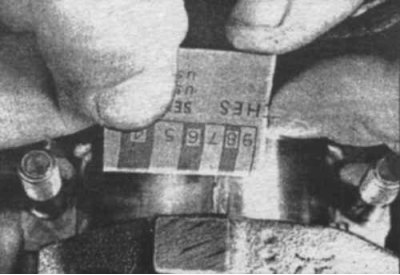
25.17 Measure the width of the Plastigodge film to determine the bearing lubrication clearance
The text of the article was taken from the website MITSUBISHIMAN.ru
17. Compare the width of the crushed film with the special scale supplied with the film to check the size of the lubrication gap (25.17).
18. If the clearance is different from the required value, install bearings of a different size. Check that there is no dirt or oil between the bearings and the connecting rod or cap. If the crushed film is wide at one end, the crankshaft journal is probably tapered.
Final installation of connecting rods
19. Remove traces of Plastigodge film.
20. Check that the surface of the bearings, connecting rods and caps are perfectly clean, then lubricate the bearings with an even layer of molybdenum grease.
21. Install the connecting rod onto the journal, install the cap and tighten the mounting nuts to the required torque in three stages.
22. Install the remaining pistons and connecting rods in the same manner.
23. After all the pistons and connecting rods are installed, turn the crankshaft a little by hand and check that nothing interferes with its rotation.
24. Check the axial play of the connecting rods.