



Contents: Electronic control unit (ECU) ⤓ Coolant temperature sensor ⤓ Throttle Position Sensor (TPS) ⤓ Engine speed sensor ⤓ Oxygen sensor (lambda probe) ⤓ Vacuum circuit breaker ⤓ Feedback Solenoid Valve (FBSV) ⤓ Solenoid Closed Circuit Valve (SCSV) ⤓
The Aisan closed-loop carburetor provides positive control of the air-fuel ratio with maximum pollution reduction. The electronic control unit (ECU) receives signals from various sensors and then modulates two electromagnetic valves (FBSV, SCSV), installed in the carburetor to regulate the air-fuel ratio. The ECU also regulates the ignition timing, intake and valve opening, and controls the electromagnetic valves.
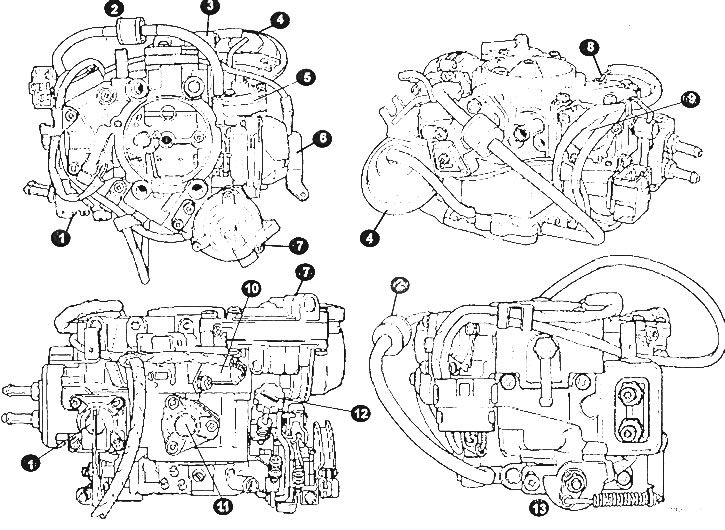
The main elements of the Aisan carburetor
1 - accelerator pump; 2 - slow-down valve; 3 - mixture control valve (MICV); 4 - vacuum chamber; 5 - Double-leaf suction interrupter; 6 - electromagnetic valve; 7 - piston booster; 8 - electromagnetic feedback valve; 9 - float chamber valve; 10 - electromagnetic valve for free fuel shut-off; 11 - enrichment valve; 12 - idle speed adjusting screw (SAS 1); 13 - throttle potentiometer.
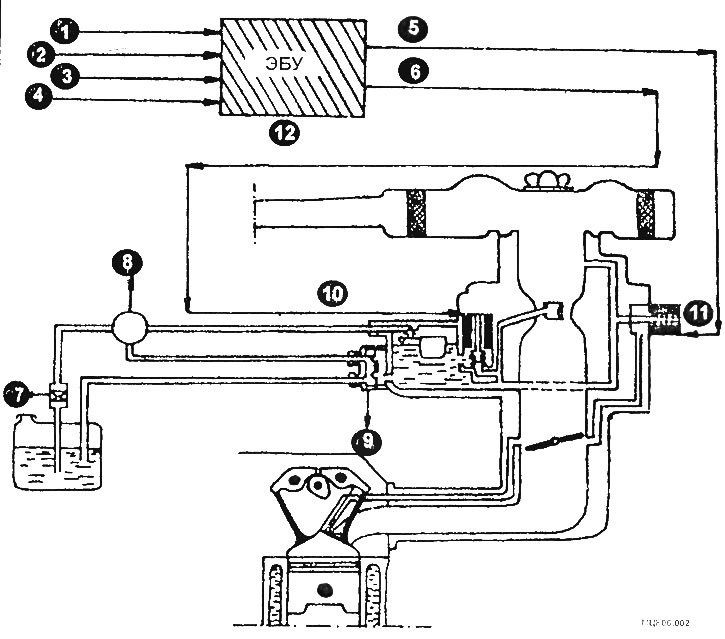
Components of the carburetor control system
1 - speed sensor; 2 - throttle position sensor; 3 - oxygen sensor; 4 - Engine coolant temperature sensor; 5 - electromagnetic free-closing valve; 6 - electromagnetic feedback valve; 7 - fuel filter; 8 - fuel pump; 8 - carburetor accelerator pump housing; 10 - Feedback solenoid valve (FBSC); 11 - Solenoid feedback valve (SCSV); 12 - electronic control unit (ECU).
Electronic control unit (ECU)
Based on the information received from various sensors during operation, the ECU controls and manages the output and actuators that regulate the optimal fuel-air mixture. The ECU usually consists of an 8-bit microprocessor.
Coolant temperature sensor
This sensor is installed in the coolant channel of the intake manifold. The sensor is a thermistor. The ECU determines the engine temperature through the output voltage of the sensor and uses it to optimally enrich the mixture on a cold engine.
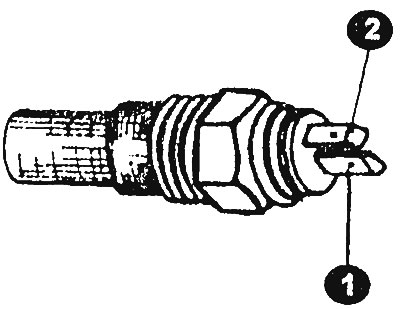
Throttle Position Sensor (TPS)
TPS is a variable resistor that rotates with the throttle shaft, determining its rotation angle. When the shaft rotates, the sensor's output voltage changes, causing the ECU to control the opening of the throttle by changing this voltage. Using this signal, the relay signal, and other signals, the ECU maintains the optimum fuel-air mixture ratio.
Engine speed sensor
Twice per revolution of the crankshaft, there is a sudden increase in voltage at the negative pole of the ignition coil. By detecting these voltage changes and changing the time between peak voltages, the ECU calculates engine speed, determines its operating mode, and regulates the fuel-air mixture composition and ignition timing.
Oxygen sensor (lambda probe)
The oxygen sensor installed in the intake manifold uses the principle of an oxygen concentration element with a constant electrolyte. This element is characterized by a change in output voltage at an air-fuel ratio close to stoichiometric.
Using this characteristic, the sensor detects the oxygen concentration in the exhaust gases and transmits this information to the ECU, which determines whether the air-fuel mixture is richer or leaner than the stoichiometric ratio and includes feedback to adjust the air-fuel mixture toward the stoichiometric ratio. With this ratio, the three-way catalytic converter has the optimum ability to clean exhaust gases.
Vacuum circuit breaker
This is a contact type switch, actuated by the vacuum in the intake manifold. When the valve closes, the vacuum pressure in the intake manifold acts on the vacuum switch, closing its contacts. The ECU receives a signal that the valve opening is close to the idle opening.
Feedback Solenoid Valve (FBSV)
The valve is installed in the cover of the carburetor float chamber. The ECU regulates the composition of the fuel-air mixture by changing the FBS duty cycle. The greater the degree of loading, the leaner the fuel-air mixture.
Solenoid Closed Circuit Valve (SCSV)
This valve is located in the carburetor float chamber cover. The ECU regulates the free fuel flow system in the carburetor by changing the valve operating cycle.