



All seasonal motor oils can be used for the engine. All-season motor oils have the advantage of being suitable for the temperature difference (summer/winter). All-season motor oils are based on low-viscosity seasonal motor oil (e.g. 10W). Due to the so-called hardener, the oil is stabilized in a hot state, therefore it provides the necessary oiliness for any operating condition. If you use all-season motor oil, you need to take a modern oil with a wide viscosity range (e.g. 10W-40, 15W-50).
The letter "W" in the SAE system means that the oil is suitable for winter. When using light-flow oils, we are talking about all-season oils, to which a friction coefficient reducer is added, due to which fuel savings of up to 2% are ensured. Light-flow oils have low viscosity (for example, 10W-30). They require non-standard base oils (synthetic oils). Basically, HD oils are used in modern engines. HD oils are alloyed oils, the lubricating properties of which are significantly improved by the addition of various chemically active substances. These additives contribute to better protection against corrosion and oxidation phenomena. In particular, they provide a slight tendency to form slag in the engine crankcase, better viscosity, cleaning and dissolving properties. Cleaning and dissolving additives not only reduce the formation of residues in the engine, but also have the ability to dissolve these residues, distribute them and other impurities in the engine oil and constantly keep them in suspension, so when changing the oil, impurities are also drained. The quality of HD engine oil is determined by the API system (API - American Petroleum Institute). It is designated by two letters. The first letter indicates the area of application S - service, intended for gasoline engines, C - commercial, intended for diesel engines. The second letter indicates the quality in alphabetical order. The highest quality according to API are oils of the SF classification for internal combustion engines with spark ignition and CD for diesel engines.
Motor oil additives
The use of additives, no matter what kind, in lubricating oils can lead to an undesirable composition of the oil mixture, and the use of oils with additives that extend their service life remains questionable, especially when using oils for severe operating conditions - this is the opinion of some leading automotive manufacturers. In any case, additives should be used very carefully.
ATTENTION: CD motor oils, which are designated by the manufacturer as oils for diesel engines, are not suitable for internal combustion engines with spark ignition. There are oils that are suitable for both gasoline and diesel engines. In this case, two classifications are indicated on the can (e.g. SF, CD).
Synthetic oils
There are many excellent and high performance oils that provide higher mileage, longer service intervals and, in some cases, better engine protection. They help the engine run smoothly, but the main difference is that synthetic oils cost 3 or 4 times more than conventional oils.
Synthetic oil is not for every car owner and every driving style, so you need to analyze the condition of your car's engine and your driving style. Thus, the results of this analysis can be the basis for using synthetic oils.
New engines and older engines with high mileage are poor candidates for synthetic oil. Synthetic oils are so slippery that they can prevent a new engine from breaking in properly, most oil manufacturers recommend waiting until the engine has been running for about 500 miles (in the break-in mode) before using synthetic oil. Older engines with wear and tear also have problems with synthetic oil, and the older the engine, the more oil it uses. Slippery synthetic oils easily pass by worn parts. If your engine is burning regular oil, it will burn synthetic oil much faster. If your car is leaking oil from seals, synthetic oil will leak even more.
Consider your driving habits. If you do a lot of highway driving at high speeds, a more expensive synthetic oil may be preferable. Heavy highway driving gives the engine a chance to warm up, collect fewer acids in the oil, and not be stressed by the long drive. Under these conditions, the oil change interval can be extended (as long as the oil filter can keep the oil in good condition) up to the limit specified by the synthetic oil manufacturer. Cars with synthetic oil get slightly better fuel economy in highway driving due to less internal friction. However, many auto experts agree that 20,000 miles is too long for any oil to last in a car.
[The text of the article was obtained from the website: mitsubishiman.ru]
Vehicles that operate in severe conditions such as stop-and-go traffic, city driving, short trips, or frequent idling require more frequent service. For engines in these vehicles, the higher cost of synthetic oils can play a significant role in the cost of maintaining the vehicle. Internal wear occurs more quickly in these vehicles, causing increased oil consumption and leaks.
ATTENTION: Mixing conventional and synthetic oils is prohibited. If you use synthetic oil, it makes sense to carry a few liters of the same oil with you, because this type of oil may not be available everywhere.
The temperatures indicated are the prevailing air temperatures. Short-term fluctuations are not play roles.
Oil application schedule depending on ambient temperature
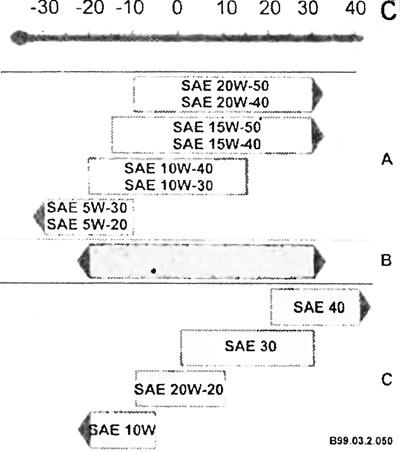
A - all-season oil; B - synthetic oil; C - seasonal oil.
Simple definition of oil viscosity
The viscosity of the oil can be roughly determined by rubbing a few drops between your fingers. The rubbed oil should not be heated. If you feel warmth, the oil has insufficient viscosity. A sharp smell of gasoline in it indicates that the oil is diluted by fuel.
CAUTION: On a heavily worn engine, low oil pressure may be caused by a clogged intake manifold coarse filter screen.