



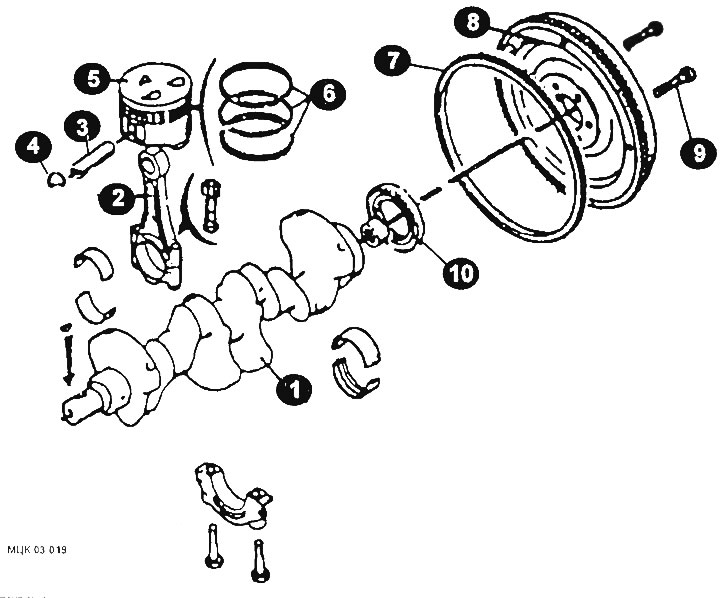
Typical elements of the crank mechanism (CRM) of a 4-cylinder engine
1 - crankshaft; 2 - connecting rod; 3 - finger; 4 - retaining ring; 5 - piston; 6 - piston rings; 7 - flywheel ring gear; 8 - flywheel; 9 - bolts; 10 - rear crankshaft oil seal.
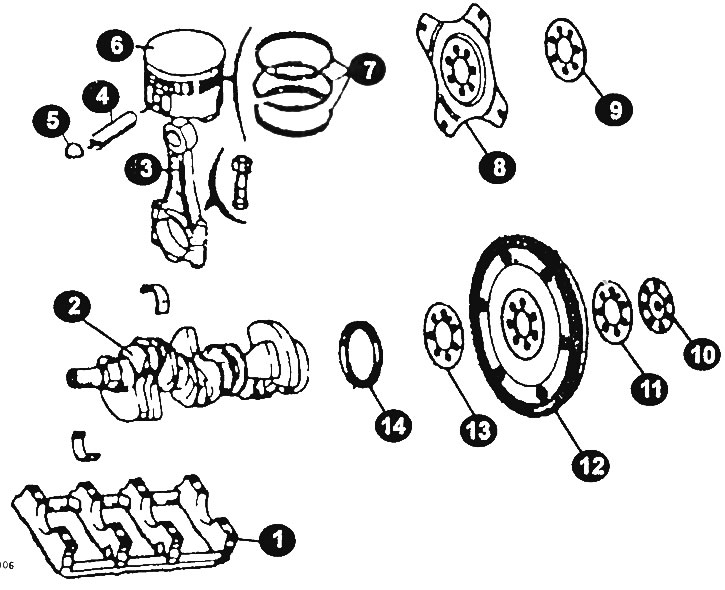
Elements of the crank mechanism of a 6-cylinder engine (6A12)
1 - main bearing cap; 2 - crankshaft; 3 - connecting rod; 4 - finger; 3 - retaining ring; 6 - piston; rings; 8 - leading disk of automatic transmission; 9 - Automatic transmission disc; 10, 11, 13 - disk; 12 - flywheel; 14 - rear oil seal.
ATTENTION: Before removing the crankshaft, the following must be removed: flywheel, oil sump, oil pump, pistons with connecting rods, rear cover of the engine block.
Before removing the crankshaft, check the end play of the shaft. Install the gauge with the indicator coaxially with the shaft and rest the gauge rod against the end or the crank.
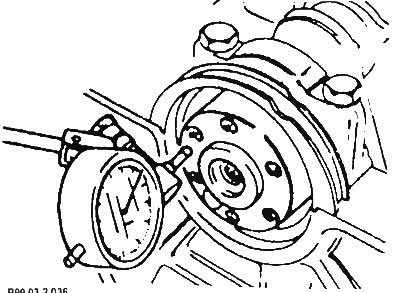
Press the shaft back to the stop and set the indicator to zero. Then press the shaft forward to the stop and record the arrow reading, which is equal to the play. If the play is greater than permissible, check the wear of the shaft thrust bearings. If wear is detected, the gap can be reduced by installing new thrust bearings.
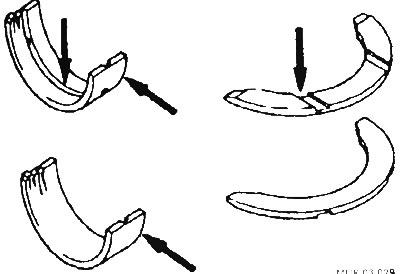
Main bearings (liners) of the crankshaft of a four-cylinder engine
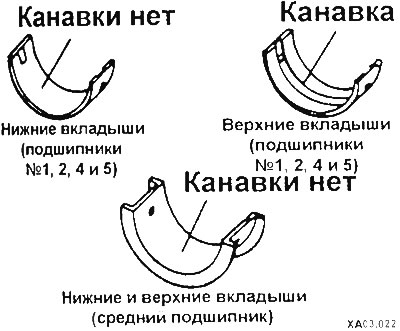
ATTENTION: On a six-cylinder engine, the middle (second) bearing has a design with two thrust half rings.
Main bearings (liners) of the crankshaft of a 6-cylinder engine
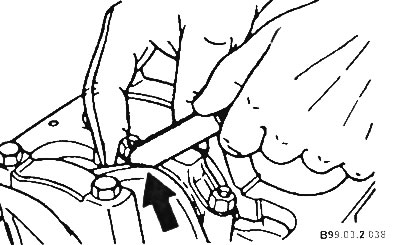
The clearance can also be measured using feeler gauges. Press the shaft forward as far as it will go. Insert the feeler gauges between the shaft and the front surface of the crankshaft bearing.
Check the markings on the main bearings. They should be numbered sequentially from the front of the engine to the rear. If there are no markings, make marks with a center punch. Often there is an arrow on the caps that points forward. If there is not, paint an arrow before removing the caps. Loosen the cap nuts in 1/4 turn increments until they can be unscrewed by hand.
Tap the caps gently with a soft-faced hammer, then remove them from the cylinder block. If necessary, use the bolts as leverage to remove the caps. Be careful not to drop the bearing shells.
Carefully pull the crankshaft out of the engine. Place the bearing shells in their places, install the bearing caps and tighten the bolts by hand.