



Check the cylinder block bores for damage, wear or scratches.
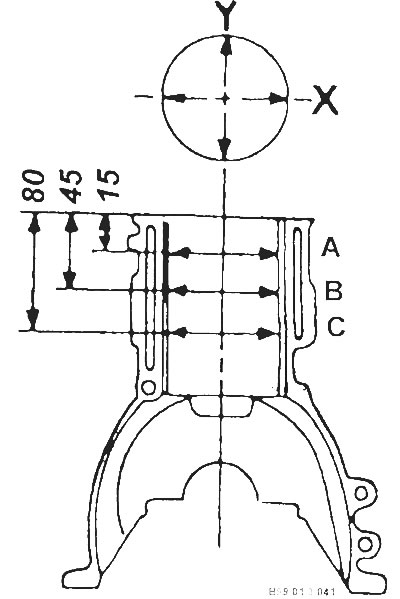
Measure the diameter of each cylinder hole just below the roller in the center and at the bottom.
Typical cylinder bore inspection
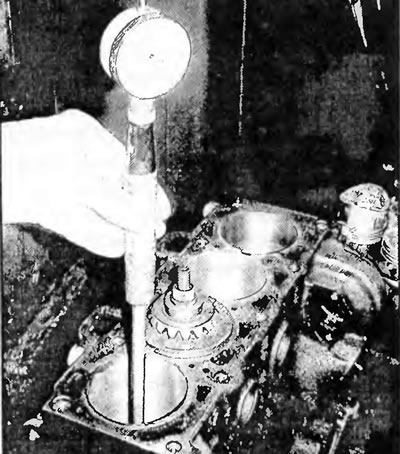
ATTENTION: On the bottom side of the block, opposite the cylinders, there are marks corresponding to the cylinder size group.
Next, measure the diameter of each cylinder at the same points, but perpendicular to the crankshaft axis. Compare with the technical data.
Four-cylinder engine
If there are no precise measuring instruments, the clearance between the piston and the cylinder wall can be measured with a feeler gauge.
The feeler gauge must be inserted between the wall and one of the piston support surfaces at an angle of 90° to the piston ring hole).
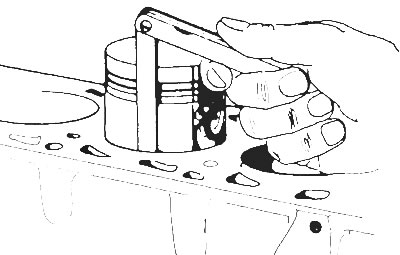
The piston should slide along the cylinder (with the feeler gauge inserted) under moderate pressure.
If the thickness of the feeler gauge equals the maximum clearance value, the piston falls through or slides very easily, the clearance is greater than the permissible value and a new piston is required. If the piston jams at the bottom of the cylinder but moves freely at the top, the cylinder is conical. If, when moving the feeler gauge around the circumference, the feeler gauge gets stuck in some places, the cylinder is oval.
Repeat this operation for the remaining pistons and cylinders.
If the cylinder walls are heavily worn or scratched, the taper or ovality exceeds the permissible value, it is necessary to bore and hone the cylinders of the block in the workshop. After boring the ovality, it is necessary to use pistons and rings of a repair (larger) size. If the cylinders are in satisfactory condition, it is enough to hone them.
Cylinder honing
Typical hone for cylinder machining
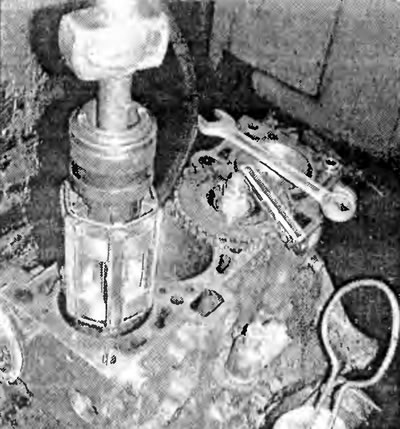
Honing is an operation for the final adjustment of engine cylinders to oversize pistons. This operation is usually performed after preliminary (rough) boring of the cylinders. Honing produces higher quality working surfaces of engine cylinders.
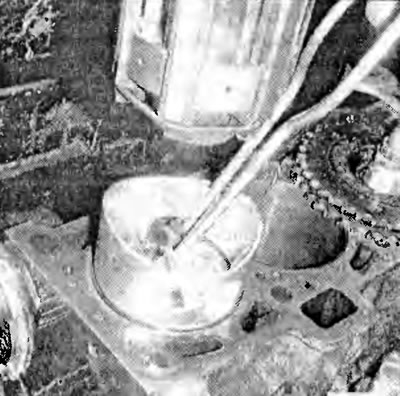
The cylinder is considered to be finally processed if the corresponding piston, under its own weight, descends into the engine cylinder without jamming or seizing.