



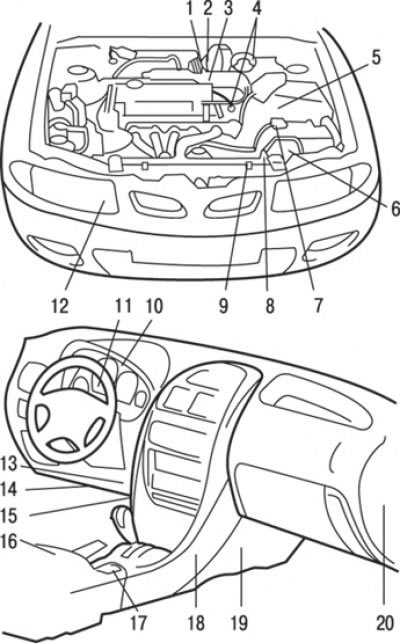
Fig. 12.1. Location of automatic transmission controls: 1 – Throttle position sensor (cars without TCL); 2 – full throttle position sensor; 3 – accelerator pedal position sensor (vehicles with TCL); 4 – engine crankshaft speed sensor; 5 – automatic transmission output shaft speed sensor; 6 – electromagnetic valve block; 7 – Automatic transmission selector switch; 8 – automatic transmission oil temperature sensor; 9 – automatic transmission input shaft speed sensor; 10 – control lamp of the selected range; 11 – vehicle speed sensor; 12 – dual pressure sensor; 13 – diagnostic connector; 14 – brake light switch; 15 – Full throttle position sensor; 16 – TCL electronic control unit (TCL-ECU); 17 – Automatic transmission mode switch; 18 – Automatic Transmission Electronic Control Unit (AT-ECU); 19 – automatic transmission control relay; 20 – electronic engine control unit (Engine-ECU)
Some cars are equipped with a four-speed automatic transmission. Since the automatic transmission is a complex unit, its repair must be carried out at a service station using special equipment. The location of the automatic transmission controls is shown in Fig. 12.1.
Diagnostics
Malfunctions of the gearbox may be caused by the following reasons:
- poor quality adjustment;
- faults in the hydraulic system;
- faults in the mechanical system;
- malfunctions in the computer or the computer's electrical circuit.
First of all, check the level and condition of the oil in the gearbox and the adjustment of the rods.
Preliminary control
1. Take a test drive to warm up the transmission.
2. Check the level of working fluid in the gearbox.
3. Check the engine idle speed.
4. Check the accelerator cable for freedom of movement and adjust it if necessary.
5. Check the operation of the gear selection mechanism.
[Article reprinted from the website www.MitsubishiMan.ru]
6. Check for leaks at the gasket and sealing ring locations in the gearbox.
Diagnostic functions
If a malfunction occurs in one of the following components that ensure normal operation of the automatic transmission (AT), the "N" position indicator lamp of the AT selector lever starts to flash at a frequency of approximately 1 Hz. In this case, it is necessary to check the fault codes.
Elements whose malfunction causes the blinking of the "N" position lamp of the automatic transmission selector lever:
- engine crankshaft speed sensor;
- input shaft speed sensor;
- output shaft speed sensor;
- one of the electromagnetic control valves;
- mismatch of gear shift moments.
Caution! If the N·mode indicator lamp flashes at a frequency of approximately 2 Hz (faster than 1 Hz), this means that the automatic transmission fluid temperature is too high. Park the vehicle in a safe place and wait until the N·mode indicator lamp goes out.
The fault codes can be read either using a special MUT-II device or using the "N" position lamp of the automatic transmission selector lever.