



Contents: If the motor shaft does not rotate…⤓ Starting the engine by towing ⤓ Jump starting the engine from a…⤓ Bleeding the fuel system ⤓ If the engine is too hot ⤓
If the motor shaft does not rotate or rotates slowly
Cars with automatic transmission
Make sure the control lever is in position N or P.
Check that the clamps at the battery terminals are securely fastened and that they are clean.
Turn on the interior light. If it does not light, or lights dimly, or goes out when the starter is engaged, the battery is dead.
Cars without catalyst
You can try to start the engine using an external battery or, if the car has a manual transmission, you can start it by pushing it.
Cars with a catalytic converter
The engine can be started using an external battery, but do not tow or push the car. The catalytic converter may overheat and then there is a risk of fire.

If the engine shaft rotates at a normal speed, but the engine does not start
1 - ignition coil; 2 - spark plugs; 3 - distributor.
Check the fuel level.
Check all butt joints at the ignition coil (1), distributor (3) and spark plugs (2) to ensure they are securely seated.
If the engine is warm or there is a smell of unburned fuel, the engine has probably received too much fuel.
Cars without catalyst
If the engine still does not start, remove the spark plugs and dry them. Crank the engine for about 20 seconds with the starter and screw the spark plugs back in.
If the engine still does not start, it needs to be adjusted or repaired. Contact a specialized workshop.
Starting the engine by towing
CAUTION: If the vehicle has an automatic transmission and a catalytic converter, the engine must not be started by pushing the vehicle.
Turn the ignition key to the ON position and engage 2nd gear.
With the clutch pedal fully depressed, wait until the towing vehicle gradually sets your car in motion - to a speed of about 15 km/h. Remember that the brake pedal must be pressed harder if the engine is switched off.
At 15 km/h, hold the accelerator pedal approximately halfway down and slowly release the clutch to allow the engine to start.
Once the engine has started, signal the driver of the towing vehicle to stop.
Press the gas pedal at the same time.
Jump starting the engine from a second vehicle
When performing this operation, the following must be taken into account:
The cross-section of the starting cable must be at least 16 mm² (diameter about 5 mm). The determining factor in this case is always a car with a discharged battery. The cross-section of the cable is usually indicated on its packaging. When buying a new starting cable, you should choose a cable with insulated terminals with a cross-section of 25 mm², since it is also suitable for engines with a smaller working volume.
Both batteries must have a voltage of 12 V.
A discharged battery can freeze at temperatures as low as -10°C.
Before connecting the jumper cable, it is necessary to defrost such a battery.
The discharged battery must be properly installed in the vehicle.
Place both vehicles so far apart that there is no contact between them with metal parts. Otherwise, voltage may occur when connecting the positive terminals.
Apply the handbrake on both vehicles. Set the gearshift levers to neutral.
Turn off all power consumers.
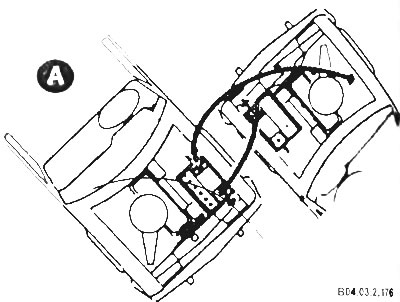
The engine of the vehicle supplying voltage (A) must be idling.
The jumper cables must be connected in the following sequence:
- clamp the red cable to the positive terminal of the discharged battery;
- press the other end of the red cable onto the positive terminal of the battery that supplies voltage;
- clamp the black cable to the negative terminal of the battery that supplies voltage;
- connect the other end of the black cable to a well-cleaned place, for example, to the engine body of the car being started. This will help avoid losses on the "ground".
The original material is posted on the website: mitsubishiman.ru
CAUTION: When connecting the cable to the negative terminal of an empty battery, an explosion may occur.
Check the battery terminals again for proper connection, making sure the cables do not come into contact with rotating parts such as the radiator fan.
CAUTION: The cable terminals must not touch each other or come into contact with ground (body or chassis).
Start the engine of the car with a discharged battery and leave it on. When starting, turn on the starter for no more than 15 seconds, because with a large current, the cable and terminals heat up. For this reason, you should make pauses for cooling, lasting at least 1 minute.
Set the engine of the vehicle providing the starting to idle. As a result, it will be possible to avoid possible damage to the generator during starting by peak voltages. If the number of idle revolutions decreases, you can slightly add gas.
Do not allow open flames near the battery when starting, as it produces flammable gases.
After starting, disconnect the cables in reverse order.
CAUTION: If the above connection recommendations are not followed, there is a risk of electrolyte burns. In addition, injuries may occur if the battery explodes, and damage to the electrical systems of both vehicles may occur.
Bleeding the fuel system
If the fuel tank was completely empty and the engine stopped after refueling, the engine may not start. Then you need to pump the system with a hand pump until you feel an increasing resistance. For engines with an injection system, turn on the ignition several times for 5-10 seconds and turn it off.
If the engine is too hot
If the coolant temperature gauge shows that the engine is overheating, if you notice a loss of power, or if you hear a distinct knocking noise (detonation), then the engine is too hot.
Stop the car, let the engine idle, apply the handbrake. Turn off the air conditioning
If coolant is leaking from the radiator or coolant expansion tank or steam is coming out, turn off the engine, open the hood and wait until the steam has evaporated. If neither steam nor liquid comes out, do not turn off the engine and check if the cooling system fan is working. If not, then turn off the engine and turn off the ignition.
Check the tightness of the radiator, radiator hoses and the bottom of the car. It is acceptable if water drips from the air conditioner after use.
When the engine is running, be careful not to place your hands or clothing near the moving fan or V-belts.
If no coolant leak is detected, check the coolant expansion tank. If it is empty, add water to the tank approximately halfway while the engine is running.
CAUTION: Never attempt to remove the radiator cap while the engine and radiator are hot.
After the engine has cooled to normal temperature, check the fluid level in the reservoir again. If necessary, fill the reservoir halfway. A large loss of coolant means that there is a leak in the cooling system.