



Contents: Diagnostics ⤓ Bulkhead ⤓
Diagnostics
1. Before checking the carburetor, the following elements must be checked:
- a) Check all vacuum hoses and diaphragms for leaks and proper installation.
- b) Securely tighten all carburetor and intake manifold mounting bolts and nuts.
- c) Perform a compression test in the cylinders.
- d) Clean and replace spark plugs if necessary.
- d) Check the high voltage wires.
- e) Check the ignition coil primary winding wires.
- g) Check the ignition timing.
- c) Check the fuel pump.
- i) Check the operation of the damper that regulates the temperature of the incoming air.
- k) Check/replace the air filter, l) Check the crankcase ventilation system, m) Check/replace the fuel filter.
- n) Check that the exhaust pipes are not clogged.
- o) Check the operation of the exhaust gas recirculation valve.
- p) Check the operation of the air damper.
- p) Check the fuel system for leaks or deformation of fuel lines.
- c) Check the operation of the accelerator pump with the engine off.
- t) Check the fuel used.
- u) Check the timing adjustment.
- f) Contact specialists to check the electronic systems of the engine and carburetor.
[The original material is here: www.MitsubishiMan.ru]
Bulkhead
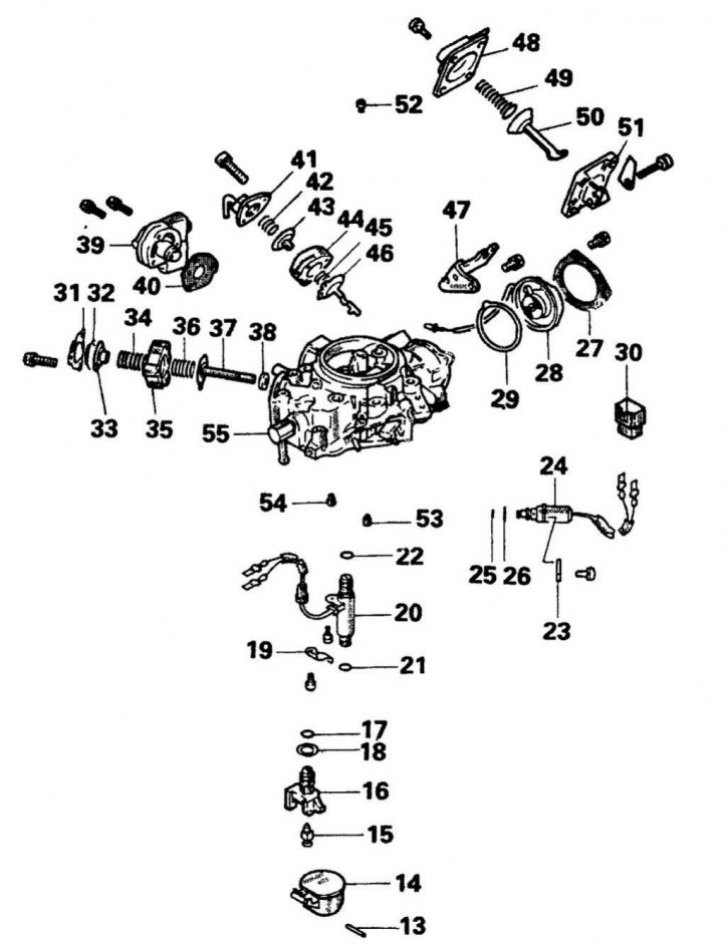
10.2a Mitsubishi Carburetor Cover Elements
13. Pin; 14. Float; 15. Needle valve; 16. Needle valve seat; 17. Sealing ring; 18. Gasket; 19. Fastening; 20. Electromagnetic valve of the feedback system; 21. Sealing ring; 22. Sealing ring; 23. Fastening; 24. Solenoid valve for gradual fuel supply cut-off; 25. Sealing ring; 26. Sealing ring; 27. Record; 28. Bimetallic spiral; 29. Gasket; 30. Connection connector; 31.Cover; 32. Diaphragm; 33. Spring seat; 34. Spring; 35. Body; 36. Spring; 37. Diaphragm; 38. Valve; 39. Solenoid valve for mixture control; 40. Gasket; 41. Lid; 42. Spring; 43. Diaphragm; 44. Body; 45. Spring; 46. Diaphragm; 47. Bracket; 48. Lid; 49. Spring; 50. Diaphragm; 51. Body; 52. Primary chamber main air jet; 53. Primary chamber main fuel jet; 54. Secondary chamber main fuel jet; 55. Float chamber cover
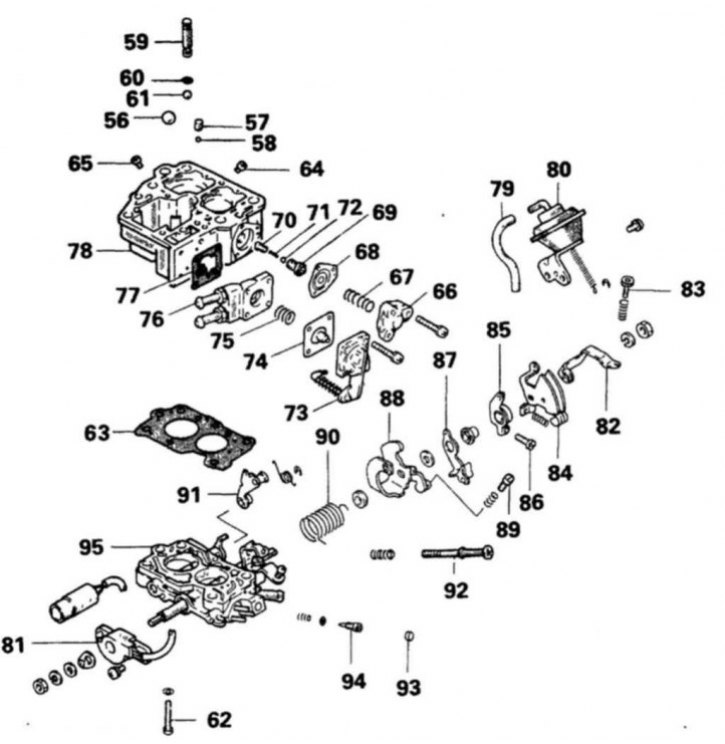
10.2b Elements of the Mitsubishi carburetor throttle block
56. Steel ball; 57. Weight; 58. Ball; 59. Plug; 60. Sealing ring; 61. Ball; 62. Screw; 63. Gasket; 64. Main fuel jet (primary chamber); 65. Main fuel jet (secondary chamber); 66. Lid; 67. Spring; 68. Diaphragm; 69. Enrichment jet valve; 70. Enrichment jet; 71. Spring; 72. Ball; 73. Pump cover; 74. Diaphragm; 75. Spring; 76. Pump body; 77. Gasket; 78. Mixing chamber; 79. Vacuum hose; 80. Vacuum chamber; 81. Throttle position sensor; 82. Lever; 83. Adjusting screw; 84. Throttle lever; 85. Cam; 86. Fast idle system adjusting screw; 87. Disconnect lever; 88. Support plate; 89. Idle speed adjusting screw; 90. Spring; 91. Secondary chamber throttle lever; 92. Idle speed adjusting screw; 93. Plug; 94. Mixture composition adjustment screw; 95. Throttle block
2. To overhaul the carburetor, it is recommended to purchase a repair kit, which includes all the necessary gaskets, internal components, instructions for overhaul, and a list of spare parts. An alternative to overhauling the carburetor is to purchase a reconditioned or new carburetor. Make sure that the new carburetor is the same model as the old carburetor. The carburetor designation is usually indicated on a plate on top of the carburetor or an identification number is stamped on the wall of the float chamber. When overhauling the carburetor, follow the figures provided (10.2a and 10.2b).