



Contents: Disassembly ⤓ Valve springs ⤓ Valves ⤓ Valve seats ⤓ Valves ⤓ Rocker arms ⤓ Cylinder head ⤓
Disassembly
Drain the oil from the engine (if it has not been drained).
Remove all attachments.
Remove the clutch. When unscrewing the mounting bolts, secure the flywheel with a large screwdriver. Mark the relative positions of the clutch and flywheel. Unscrew the mounting bolts evenly and gradually.
After loosening the generator mounting bolts, remove the drive belt, generator and belt tensioner bar.
Remove the power steering pump drive belt.
Remove the cooling fan.
Drain the oil from the engine (if it has not been drained).
Remove all attachments.
Remove the clutch. When unscrewing the mounting bolts, secure the flywheel with a large screwdriver. Mark the relative positions of the clutch and flywheel. Unscrew the mounting bolts evenly and gradually.
After loosening the generator mounting bolts, remove the drive belt, generator and belt tensioner bar.
Remove the power steering pump drive belt.
Remove the cooling fan.
Remove the upper timing belt cover
After unscrewing the bolts, remove the cylinder head cover
Secure the crankshaft from turning and unscrew the four pulley bolts. Remove the adapter flange and pulley.
Loosen the bolts and remove the lower timing belt cover.
Turn the crankshaft so that the piston of the 1st cylinder is set at TDC of the compression stroke. To do this, install the crankshaft so that the timing mark on the camshaft wheel (1) is opposite the mark (2) on the fuel pump bracket. Make sure that the rocker arms of the valves of the first cylinder move freely. Otherwise, turn the crankshaft one more revolution.
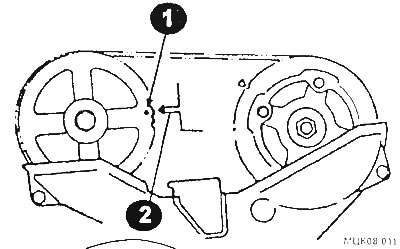
Mark the position of the belt on the wheel.
Valve springs
Check the length of the springs in a free state and under load. If the length does not correspond to the required value, replace the springs.
Check the springs for deviation from the vertical. If the gap along the spring length exceeds 1.6 mm, replace the spring.
When assembling, the springs are installed so that the color markings are facing upwards. New springs must have the same markings as those being replaced.
Valves
Remove the valve stem seals from the valves and guide bushings.
Check the condition of the valves and guide bushings. Clean the inside surface of the guide bushing with a rag soaked in gasoline.
Check the clearance between the valve and the guide bushing. To do this:
- Having installed the dial indicator, remove the valve from the end of the sleeve by 30 mm.
- Place the indicator leg against the valve head and move the indicator arrow to zero.
- Rock the valve in the sleeve.
- If the reading exceeds 0.20 mm, the valve or bushing should be replaced.
The guide bushings are pressed out using a mandrel from the side of the rocker arm shafts.
ATTENTION: Guide bushings are pressed into the diesel head at room temperature.
Press in new bushings. Spare parts include repair bushings with a diameter increased by 0.05; 0.25 and 0.50 mm (marked "5", "25" and "50" respectively). Before pressing in the holes for the guide bushings in the cylinder head, ream them to the diameter of the repair bushing. When replacing the bushings, keep in mind that the guide bushings of the intake and exhaust valves may have different lengths.
Before pressing out, measure the height to which the guide bushing protrudes. Press in the new bushing from the combustion chamber side so that the protrusion of the new bushing is equal to 1 3.7-14.3 mm.
ATTENTION: On the 4D65 diesel engine, the valve guides are pressed out and pressed in at room temperature of 20°C. When replacing the guides, the valve seats are ground, regardless of their condition.
Valve seats
Check the condition of the valve seats. Remove minor defects with a hand burr. Replace the valve seats if necessary. The spare parts include repair valve seats with a diameter increased by 0.3 and 0.6 mm; the holes for the seats in the cylinder head should be bored to the appropriate seat size.
After replacement, grind the seat. Then grind the valve.
After lapping, clean the cylinder head. Clean the guide bushing holes especially thoroughly.
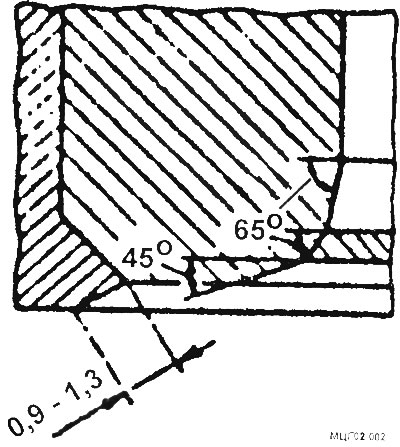
Check the width of the valve seat chamfer, which for intake and exhaust valves should be within 0.9-1.3 mm, the seat grinding angles should correspond to those shown in the figure.
Valves
Replace valves with bent stems or on the stems of which traces of burning are found. Repair of valves by grinding or turning the stem is not allowed. If traces of wear are found on the thrust surfaces of the rocker arms, then it is allowed to remove material from the end of the valve up to 0.5 mm. If the end of the valve is worn, then check the condition of the rocker arms. Carefully inspect the valves, check for cracks on the valve chamfers, traces of uneven wear. Check for cracks on the necks of the valves.
Minor defects of the valve head can be removed by grinding. If significant defects are found, the valve head is ground. After grinding and chamfering at an angle of 45°, the height of the edge of the inlet valve should be at least 0.7 mm, otherwise the valves must be replaced.
Check the clearances between the bushing and the valve using a dial indicator, for which insert the valve into the guide bushing. To do this, install the dial indicator, lift the plate from the end of the bushing by 30 mm. Rest the indicator leg against the valve head and bring it to zero, swing the valve in the bushing and read the indicator readings. If the reading exceeds 0.20 mm, then the valve or bushing should be replaced. Make a final decision after checking the valve stem diameter. If the stem diameter is less than the required value, the valve must be replaced.
Rocker arms
Check the axles and rocker arms for wear and damage. Check the rocker arm axle diameter and the rocker arm inner diameter. The difference between these diameters (the gap) should not exceed 0.01-0.05 mm. Otherwise, the shaft and rocker arm should be replaced. If wear is detected on the rocker arm bearing surfaces, grinding of the bearing surfaces is allowed. The permissible metal removal during rocker arm grinding should not exceed 0.5 mm.
A heavily worn rocker arm surface makes valve adjustments much more difficult. If, after the rocker arm bearing material has been ground to 0.5 mm, the surface is still uneven, replace the rocker arm.
Position the camshaft in the bed and tighten the six mounting bolts finger tight.
Place the rocker arms and springs on the axles.
Install the axle assembly with the rocker arms into the camshaft bearing journal covers and tighten the bolts.
Tighten the camshaft cover bolts and the roller mounting bolts to the specified torques. Check that the springs are installed correctly.
Press the camshaft seal into the bore at the front of the cylinder head. The seal should be flush with the cylinder head surface.
Lubricate the working lips of the seal with consistent grease. Lubricate the central groove of the segment plug with sealant and install the plug in place.
Further assembly is carried out in reverse order.
Cylinder head
Clean the cylinder head, remove any remaining gasket material from the contact surfaces of the head.
Remove carbon deposits from combustion chambers. Run and clean all threaded holes. Check the deformation of the contact surface of the head. If the deviation from the plane is less than the limit (0.10 mm), then the head should be re-ground. If the deviation from the plane exceeds 0.10 mm, at least in one place, then the cylinder head should be replaced.