



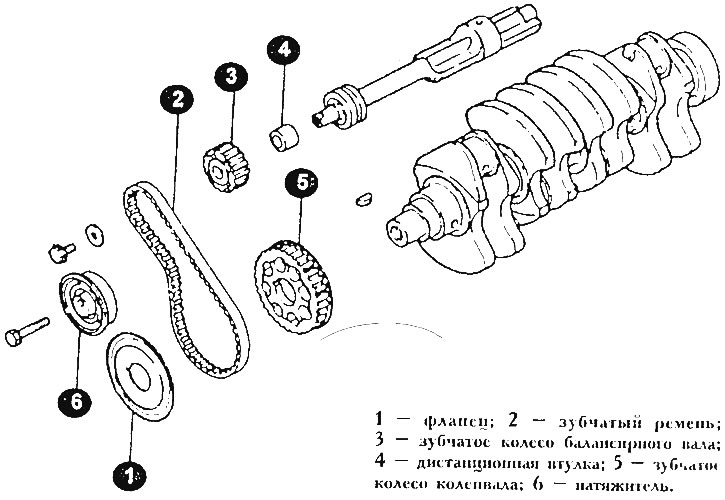
Balance shaft drive
1 - flange; 2 - toothed belt; 3 - balance shaft gear; 4 - spacer sleeve; 5 - crankshaft gear; 6 - tensioner.
The valve timing components can be replaced without removing the engine from the vehicle. The procedure for removing these components is discussed in the section that describes the procedure for disassembling the engine.
The description of the adjustment procedure given below is based on the assumption that all the valve timing components have been removed (for example, during a major overhaul or to replace components).
Install the balance shaft gear and tighten the wheel mounting bolt.
Place the drive wheel on the crankshaft nose. Align the timing marks (A) and (B) on each wheel.
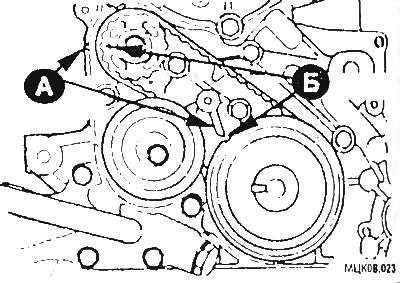
Place the belt over both sprockets so that the side of the belt that the tensioner rests against is taut.
Install the tensioner. The center of the tensioner pulley should be to the left of its mounting bolt. The flange flange of the pulley should face outward (away from the engine). The figure shows the tensioner pulley after installation on the engine.
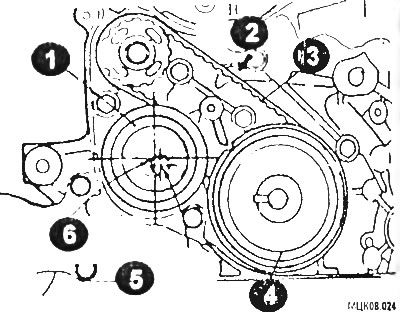
1 - tensioner; 2 - belt tension side; 3 - toothed belt; 4 - flange flange; 5 - mounting bolt; 6 - center of the tensioner roller.
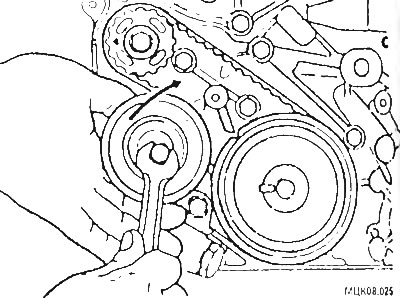
Move the tensioner in the direction of the arrow, while lifting it with your finger to give the required tension to the belt. In this position, fix the tensioner by tightening the bolt. When tightening the bolt, hold the shaft from turning.
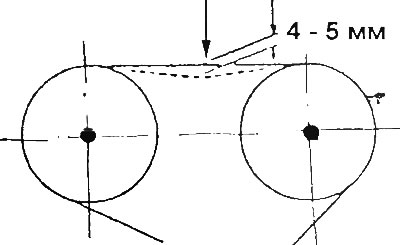
Make sure that the alignment of the installation marks on the wheels and the front cover is not disturbed. Check the belt tension by pressing with your index finger in the place shown in the figure. The belt deflection should be 5-7 mm.
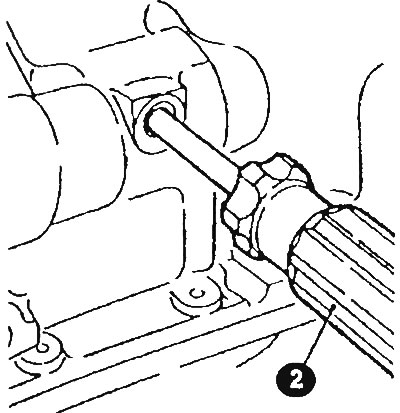
Install the oil pump wheel and tighten the bolt to 50-60 Nm. Check the correct installation of the balance shaft with a screwdriver (2) with an 8 mm blade inserted into the hole in the left side of the cylinder block. If the screwdriver goes in by 60 mm, the shaft is set correctly; if the screwdriver blade goes in by 25 mm, turn the oil pump wheel by 1 revolution and check the alignment of the installation marks again. Remove the screwdriver only after installing the belt.
Installing the camshaft belt
Insert the tensioner into the lowest position on the fuel pump bracket slot.
Remove the spark plugs.
Loosen the locknuts of the adjusting screws and unscrew all the screws so that their ends protrude by 2 mm.
Turn the crankshaft so that the piston of the 1st cylinder is set to TDC of the compression stroke; check the alignment of the marks.
Put the belt on, winding it on each wheel in turn. When putting the belt on, take up the slack between all the wheels and also between the pulley and the adjacent wheels.
First, place the belt on the crankshaft sprocket, then on the tension roller, on the camshaft sprocket, then on the fuel injection pump sprocket, and finally on the oil pump sprocket. Rotate the crankshaft half a tooth of the camshaft sprocket in the direction opposite to the normal belt movement. This will remove the slack from the belt along its entire length. Finally, place the belt on the tensioner.
Remove the screwdriver that was inserted into the cylinder block. Loosen the tensioner mounting bolt by 1/4 turn, and the tensioner roller will rest against the belt.
The original material is posted on the website: www.mitsubishiman.ru
Turn the crankshaft counterclockwise by 3 teeth of the camshaft wheel, starting from the installation mark, fix the wheel in this position. Make sure that all the teeth of the gear wheels enter the grooves of the belt. Turn the crankshaft clockwise until the marks on the camshaft wheel and on the front cover are aligned.
Check the belt tension by the amount of deflection when pressing with your index finger at the location shown in the figure. If the deflection is different from the norm, repeat the tension adjustment.
Make sure that the alignment of all marks is not disturbed, turn the crankshaft in the direction of normal rotation and check the alignment of marks again. Do not turn the crankshaft in the opposite direction.
Install the removed parts in reverse order.