



Contents: Removal ⤓ Installation ⤓
A defective injector causes severe engine detonation and, consequently, damage to the bearings. Leaving the engine running at idle, slightly loosen the union nuts of the injection pipeline one by one. If the detonation disappears when any union nut is loosened, this indicates a defect in the corresponding injector.
If you loosen the union nut at idle speed and the RPM does not change, this means that the corresponding injector is defective. The injector can also be checked using a pressure gauge.
False ignitions; detonation in one or more cylinders; engine overheating; low engine power very strong black exhaust; high fuel consumption - this indicates problems with the injector.
Removal
Clean the outside of the injection line and fuel return lines.
Remove the injection pipe as a set by loosening the union nuts on the pump and injectors, holding the supply pipe mount and the injector mount with a wrench without disturbing the bend shape.
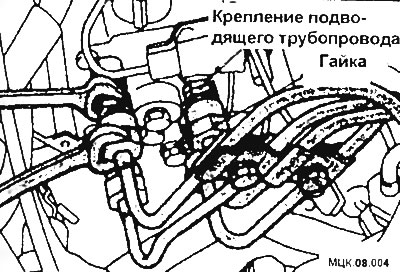
Disconnect the fuel return hose.
Loosen the fuel return pipe nuts and remove the fuel return pipe.
Using an extended socket, unscrew the injectors and put them back in the order they were removed.
Close the nozzle holes with plugs.
Replace the retainer seal and nozzle seal in each hole.
Installation
Clean the injector bores by inserting 4 new retainer seals and injector seals into the bores.
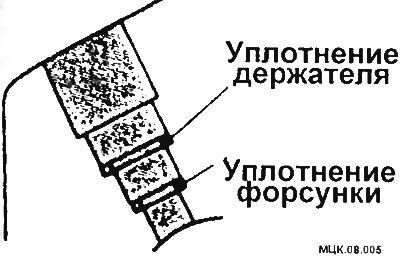
Install the injectors and tighten to 60 Nm without overtightening the holders.
The article was taken from the website: mitsubishiman.ru
Install the fuel return pipes with 4 new gaskets and tighten the nuts to 40 Nm. Tighten the injection pipe to 35 Nm, holding the pipe holders or injector holders with a wrench.
Secure the pipeline bracket.
Loosen the union nuts of the injection pipes on all injector holders.
Turn the engine over with the starter until diesel fuel appears at the injection pipes.
Tighten the injection tubes. Remove air from the fuel system.