



Checking the injector
1. Disconnect the connector from the injector.
2. Measure the resistance between the connector contacts.
The nominal value is 13-16 Ohm at 20°C.
3. Connect the injector connector.
Checking the spray pattern and nozzle tightness
1. Relieve any residual pressure in the fuel line to prevent fuel splashing.
2. Remove the nozzle.
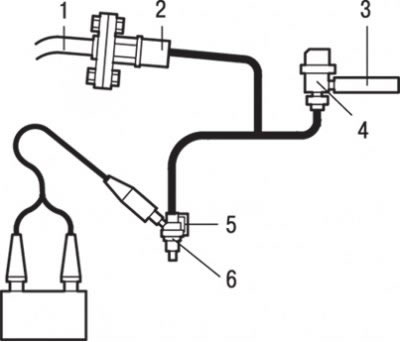
Fig. 7.16. Special tool for checking the spray pattern and nozzle tightness: 1 – high pressure fuel hose; 2 – adapter; 3 – fuel return hose; 4 – fuel pressure regulator; 5 – nozzle; 6 – special clamp
3. Assemble the special tool (injector test kit), adapter, pressure regulator and clamps as shown in Fig. 7.16.
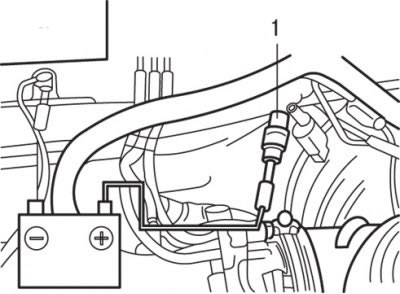
Fig. 7.9. Connecting the service connector (1) of the fuel pump to the positive terminal of the battery to check the operation of the fuel pump
4. To turn on the fuel pump, connect the wire (with alligator clips) from the positive terminal of the battery to the black service connector terminal of the fuel pump (see Fig. 7.9).
5. Activate the injector and check the quality of fuel atomization from the injector.
The condition of the nozzle is satisfactory if the nozzle provides normal spraying.
6. Disconnect the wires from the injector connector contacts and check the tightness of the spray nozzle and the injector shut-off needle.
Norm: 1 drop or less per minute.
7. Connect the wires from the battery terminals to the injector terminals without turning on the fuel pump. Then, after the injector stops spraying fuel, disconnect the special tool and install the injector in place.
Removal
1. Disconnect the cable from the negative terminal of the battery.
2. Relieve fuel pressure (to prevent fuel splashing).
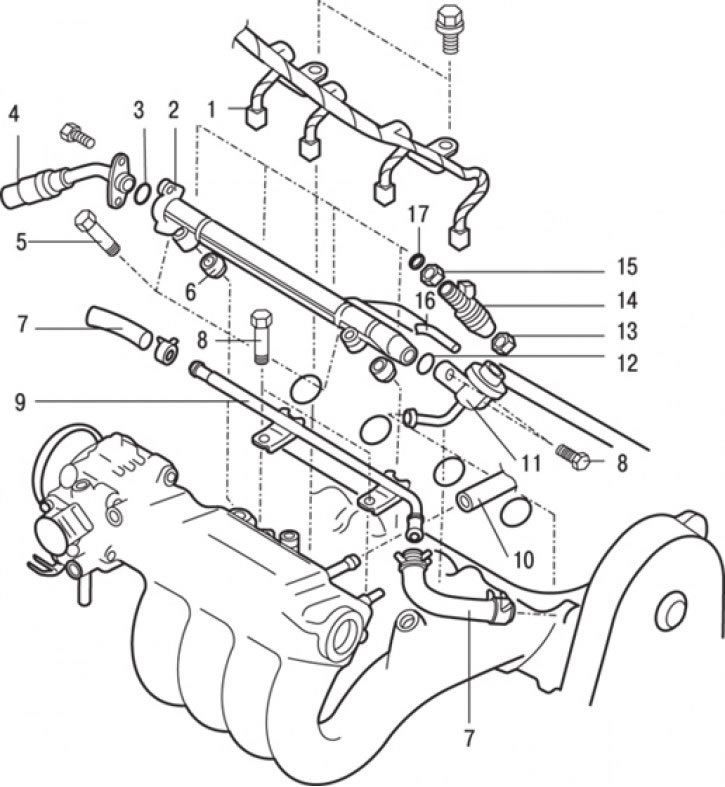
Rice. 7.17. Injectors: 1 – injector connector; 2 – fuel rail; 3 – O-ring gasket; 4 – connection of the high-pressure fuel hose flange to the fuel rail; 5 – bolt (10–13 Nm); 6 – sealing gasket; 7 – fuel return hose; 8 – bolt (9 Nm); 9 – fuel return pipe; 10 – Positive crankcase ventilation (PCV) hose; 11 – fuel pressure regulator; 12 – O-ring gasket; 13 – sealing gasket; 14 – nozzle; 15 – sealing sleeve; 16 – vacuum hose; 17 – O-ring gasket
3. Disconnect the positive crankcase ventilation (PCV) hose 10 (Fig. 7.17).
4. Disconnect the injector connectors 1.
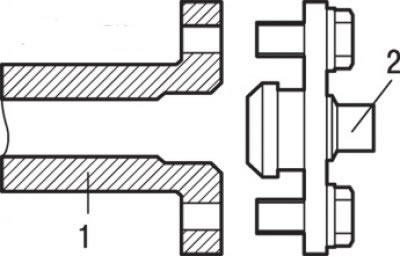
Fig. 7.18. Connection of the flange (1) of the high-pressure fuel hose to the fuel rail (2)
5. Loosen the bolts and disconnect the high-pressure fuel hose flange from the fuel rail (Fig. 7.18).
6. Remove the ring gasket 3 (see Fig. 7.17).
7. Loosen the clamps and remove the fuel return hose 7.
8. Disconnect vacuum hose 16.
9. Loosen the bolts and remove the fuel pressure regulator 11.
10. Remove the O-ring 12.
11. Loosen the bolts and remove the fuel rail 2 together with the injectors installed on it.
Caution: Be careful not to drop the injectors when removing the fuel rail.
12. Loosen the clamp and remove the fuel return pipe 9.
13. Remove sealing gaskets 6 and 13.
14. Carefully remove the injectors 14.
15. Remove the O-rings 17 from the injectors.
16. Remove the sealing bushings 15.
Installation
Installation is carried out in the reverse order of removal, taking into account the following.
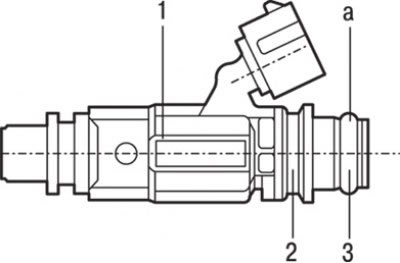
Rice. 7.19. Nozzle: 1 – nozzle; 2 – sealing sleeve; 3 – O-ring gasket; a – place of application of lubricant
1. Before installation, apply a small amount of clean engine oil to the O-ring (Fig. 7.19).
Caution: Be careful not to allow oil to enter the fuel rail.
2. While turning the injectors, high-pressure fuel hose and fuel pressure regulator to the right and left, carefully install the fuel rail so as not to damage the O-rings.
3. After installation, check whether the flange of the high-pressure hose in the fuel rail rotates smoothly.
[Original material on the website MITSUBISHIMAN]
4. If the fuel hose flange does not rotate smoothly in the fuel rail, the O-ring may be pinched. In this case, disconnect the high-pressure hose from the fuel rail, insert it back into the fuel rail, and check whether the hose flange rotates smoothly.
5. Tighten the high pressure fuel hose flange mounting bolts to the specified tightening torque and the fuel pressure regulator mounting bolts to 9 N·m.