



Contents: Removal ⤓ Installation ⤓
Removal
1. Disconnect the cable from the negative terminal of the battery.
2. Remove the fuel pressure in the fuel system.
3. Remove the hood.
4. Drain the coolant from the engine cooling system.
5. Remove the gearbox.
6. Remove the radiator.
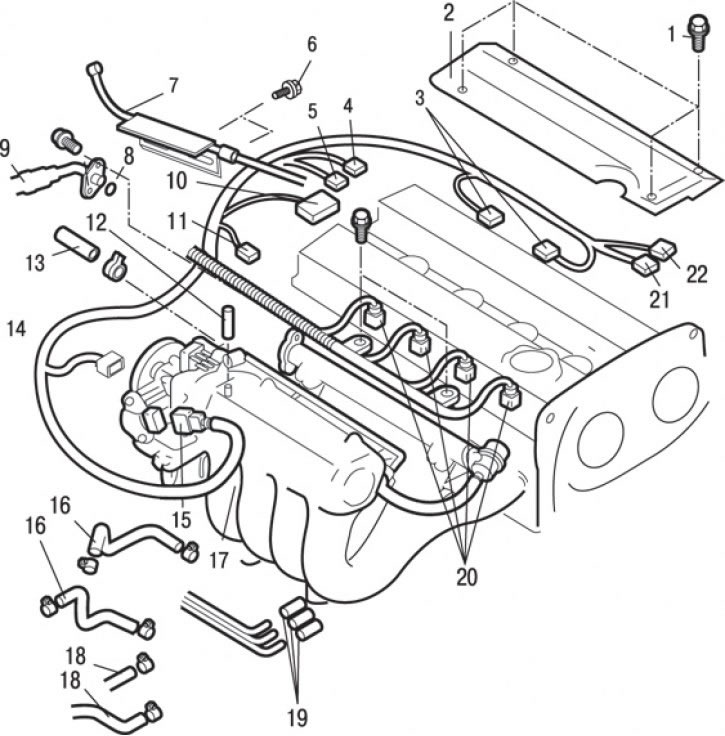
Fig. 3.64. Connecting connectors and hoses to the DOHC engine: 1 – bolt, 3.0 Nm; 2 – central cover; 3 – ignition coil connectors; 4 – coolant temperature sensor connector (on the indicator); 5 – coolant temperature sensor connector; 6 – bolt, 10 Nm; 7 – accelerator pedal cable connection; 8 – O-ring sealing gasket; 9 – high pressure fuel hose connection; 10 – ignition system malfunction sensor connector; 11 – oil pressure switch sensor connector; 12 – brake booster vacuum hose connection; 13 – Fuel return hose connection; 14 – idle speed controller connector; 15 – Throttle Position Sensor (TPS) connector; 16 – connection of cooling system hoses; 17 – knock sensor connector; 18 – connection of heater hoses; 19 – Vacuum hose connection; 20 – injector connectors; 21 – crankshaft position sensor connector; 22 – camshaft position sensor connector
7. Loosen the bolts and disconnect the cable 7 (Fig. 3.64) of the accelerator pedal.
8. Disconnect the connectors of the throttle position sensor (TPS) 15, idle air control valve 14, knock sensor 1, oil pressure switch 11, ignition system malfunction sensor 10, coolant temperature sensor 5, coolant temperature sensor (on the pointer) 4 and injectors 20.
9. Loosen the bolts and remove the central cover 2.
10. Disconnect the connectors of ignition coil 3, camshaft position sensor 22 and crankshaft position sensor 21.
11. Loosen the clamp and remove the fuel return hose 13.
12. Loosen the bolts and disconnect the high-pressure fuel hose 9 and the ring seal 8.
13. Disconnect the brake booster vacuum hose 12.
14. Disconnect the vacuum hoses 19.
15. Loosen the clamps and disconnect the coolant hoses 16.
16. Loosen the clamps and disconnect the heater hoses 18.
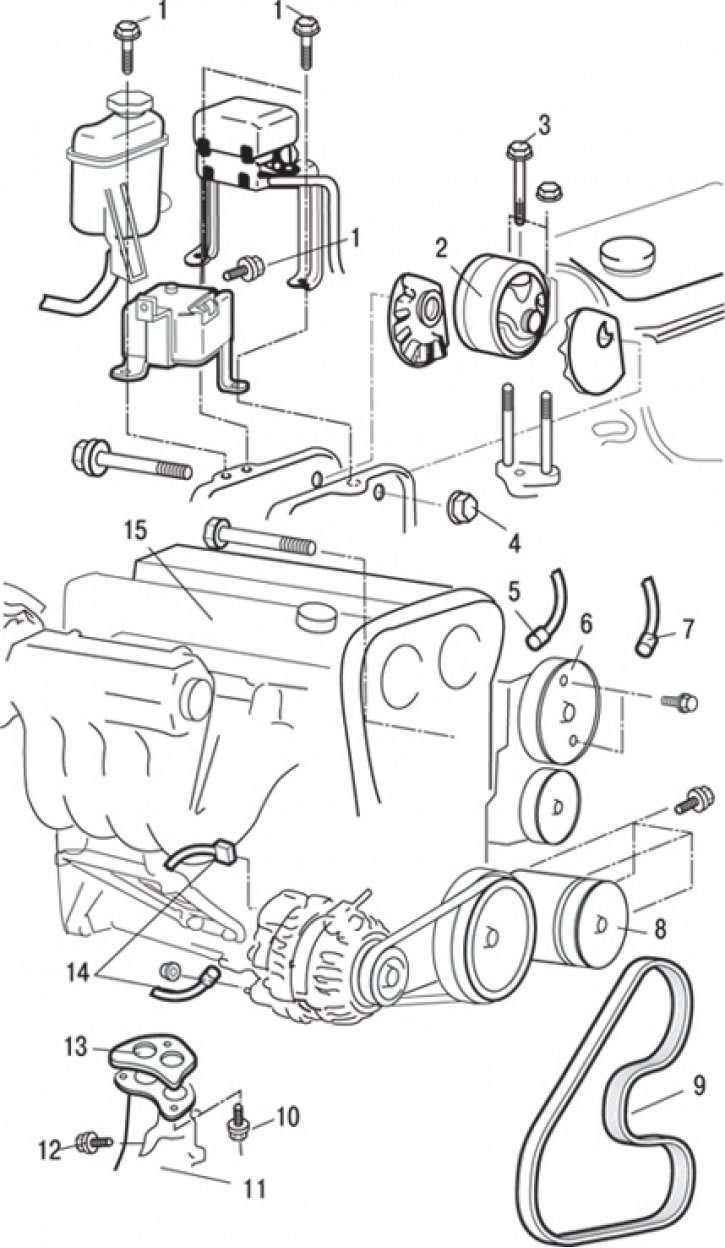
Fig. 3.65. DOHC engine: 1 – bolt; 2 – engine support bracket; 3 – bolt, 62 Nm; 4* – nut, 118 Nm; 5 – connector of the sensor (switch) of fluid pressure in the hydraulic system of the power steering; 6 – Power steering pump mount; 7 – air conditioning compressor connector; 8 – Air conditioning compressor mount; 9 – Power steering pump and air conditioning compressor drive belt; 10 – bolt, 49 Nm; 11-intake pipe of the exhaust gas system; 12 – bolt, 50 Nm; 13 – gasket; 14 – generator connector; 15 – engine assembly
17. Disconnect the connectors of the pressure sensor (switch) 5 (Fig. 3.65) of the fluid in the hydraulic system of the power steering, compressor 7 of the air conditioner and generator 14.
Caution! The fastening points marked with the (*) symbol must first be pre-tightened and then finally tightened after the vehicle has been lowered to the ground (in an unloaded state).
18. Loosen the tension and remove the belt 9 of the power steering pump and air conditioning compressor drive.
19. Unscrew the mounting bolts 6 and remove the power steering pump together with the hoses connected to it.
Attention! Tie the removed power steering pump assembly with bracket and hoses with wire and place it so that it does not interfere with the removal and installation of the engine assembly.
20. Disconnect the air conditioning compressor wire connector and remove the compressor from the bracket with the hoses connected.
Caution! Tie the removed compressor with wire and place it in a place where it will not interfere with the removal and installation of the engine.
21. Loosen the nuts and disconnect the exhaust pipe 11 and remove the gasket.
22. Unscrew bolts 1.
23. Place a hydraulic jack under the engine.
24. Remove the special tool used to remove the gearbox from the engine.
25. Secure the engine to the crossbar and hang it on a hoist or similar device.
26. Insert a wooden block between the jack support foot and the engine oil pan and lift the engine slightly to relieve the support; then remove the engine mount bracket.
27. Check that all wires (electrical connectors), hoses, etc. are disconnected from the engine, and then slowly lift the engine up out of the engine compartment.
Installation
Installation is carried out in the reverse order of removal, taking into account the following.
1. When installing the motor, carefully check that the wires, hoses and wire connectors are not pinched.
2. Place a hydraulic trolley jack under the engine (inserting a wooden block between the jack support foot and the engine oil pan) and install the engine support bracket, adjusting the engine position using the jack.
3. Support the engine with a jack and disconnect the hoist.
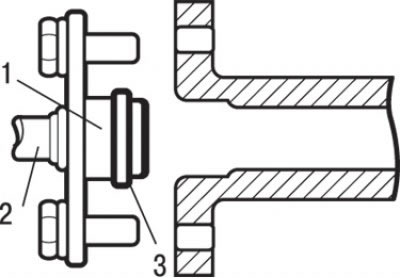
Fig. 3.44. Installing the high pressure fuel hose: 1 – place of lubrication with engine oil; 2 – high pressure fuel hose; 3 – O-ring gasket
4. When installing the high pressure fuel hose, lubricate the O-ring with a small amount of clean engine oil (see Fig. 3.44).
Caution! Do not allow oil to enter the fuel rail.
5. While slightly turning the flange of the fuel hose to the right and left, carefully insert it into the fuel rail so as not to damage the O-ring seal. After installation, check that the hose rotates smoothly in the fuel rail.
6. If the hose flange sticks when turning, the cause may be damage to the O-ring. Disconnect the flange (assembled with the hose) from the fuel rail and inspect the gasket for damage, then insert it back and check for smooth turning.
7. Tighten the mounting bolts.
8. Install the radiator.
9. Install the gearbox.
10. Adjust the accelerator pedal cable.
11. Fill the cooling system with coolant.
12. Adjust the drive belt tension.
13. Install the hood.