



Check the engine oil level and top up if necessary.
- If the amount of oil is insufficient, the oil intake may trap air.
- If there is a lot of oil, the crankshaft stirs up the oil in the crankcase, resulting in an oil-air mixture.
- Air bubbles cannot easily escape from old oil, so the amount of air in the oil increases. This mixture is compressed when it enters the high-pressure chamber (1) of the hydraulic tappet (under the effect of pressure on the hydraulic tappet).
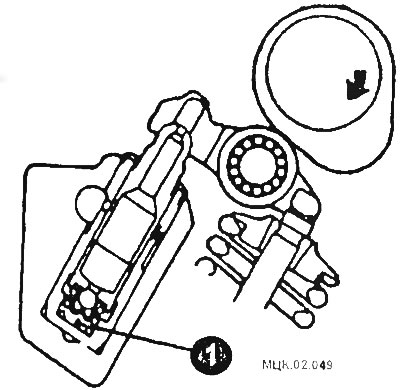
The consequence of this is the appearance of sound when the valve closes. The operation of the hydraulic tappets is restored when the air separates from the oil. Start the engine and slowly accelerate it several times. If the sound disappears, this means that the oil has been freed from air and the normal operation of the hydraulic tappets has been restored.
Gradually increase the engine speed from idle to 3000 rpm, and then gradually reduce the engine speed to idle.
CAUTION: If the vehicle has been parked on an incline for a long time or has not been used, oil may leak out of the hydraulic tappet and air may enter the high-pressure chamber instead.
If the clicking sound does not disappear after the described operations, check the condition of the hydraulic tappets.
Stop the engine.
Set the piston of the first cylinder to TDC of the compression stroke.
Press the valve rocker arm in the area marked with white arrows to check the position of the valve rocker arm.
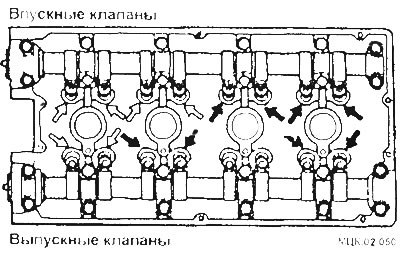
Rotate the crankshaft 360° clockwise.
Press the valve rocker arm in the area marked with black arrows to check the position of the valve rocker arm.
If the rocker arm is easily lowered when pressed when the cam lobe is in the closed valve position (see figure). In this case, the hydraulic tappet is considered to be faulty and requires replacement.
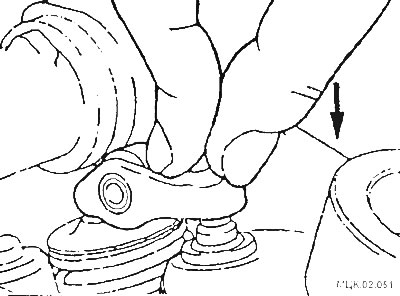
When replacing hydraulic lifters, remove air from them.