



The high voltage of the spark plug creates a spark that ignites the compressed air-fuel mixture in the combustion chamber. The engine's electronic control unit switches the primary circuit current of the ignition coil on and off, thus regulating the ignition timing.
Via the crankshaft angle sensor in the ignition distributor, the engine control unit determines the position of the crankshaft angle and creates the optimum ignition timing for the given engine condition.
If the engine is cold or the vehicle is operated at high altitude, the ignition timing is advanced slightly to optimally adapt the power to the given operating conditions.
If the engine detonates, the ignition timing slowly retards until the knocking noise stops.
When a car is equipped with an automatic transmission, the ignition timing is delayed in order to soften the moment of drive engagement and thereby reduce the shock when engaging a gear.
The ignition system of the 4G1 engine is shown in Figure 7.29.
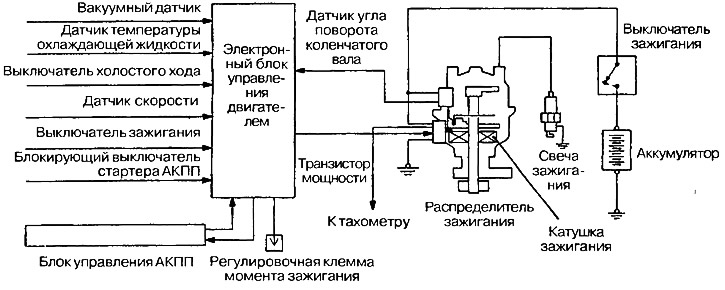
Figure 7.29. 4G1 engine ignition system
Table 7.1a. Technical data of the ignition distributor of the 4G1 engine
| Type | Contactless distributor with integrated ignition coil |
| Setting | Electronic |
| Firing order | 1-3-4-2 |
Table 7.1b. Technical data of ignition coils
| Engine | 4G1 | 4G9 |
| Ignition type | Closed single coil with integrated distributor | Closed Binary Ignition Coil |
Table 7.1c. Ignition coil
| Engine | 4G1 | 4G9 except MW | 4G9MW |
| Primary coil resistance | 0.5-0.7 Ohm | — | — |
| Secondary coil resistance | 15-22 Ohm | 14-21 Ohm | 20-30 Ohm |
The text of the article was obtained from the website www.mitsubishiman.ru